.svg&w=384&q=75 "Naijagoal logo")

Neco Williams' Disallowed Goal: New Footage Sparks Controversy
New footage has dropped, and with it a fresh twist in one of the weekend’s most argued-over calls.
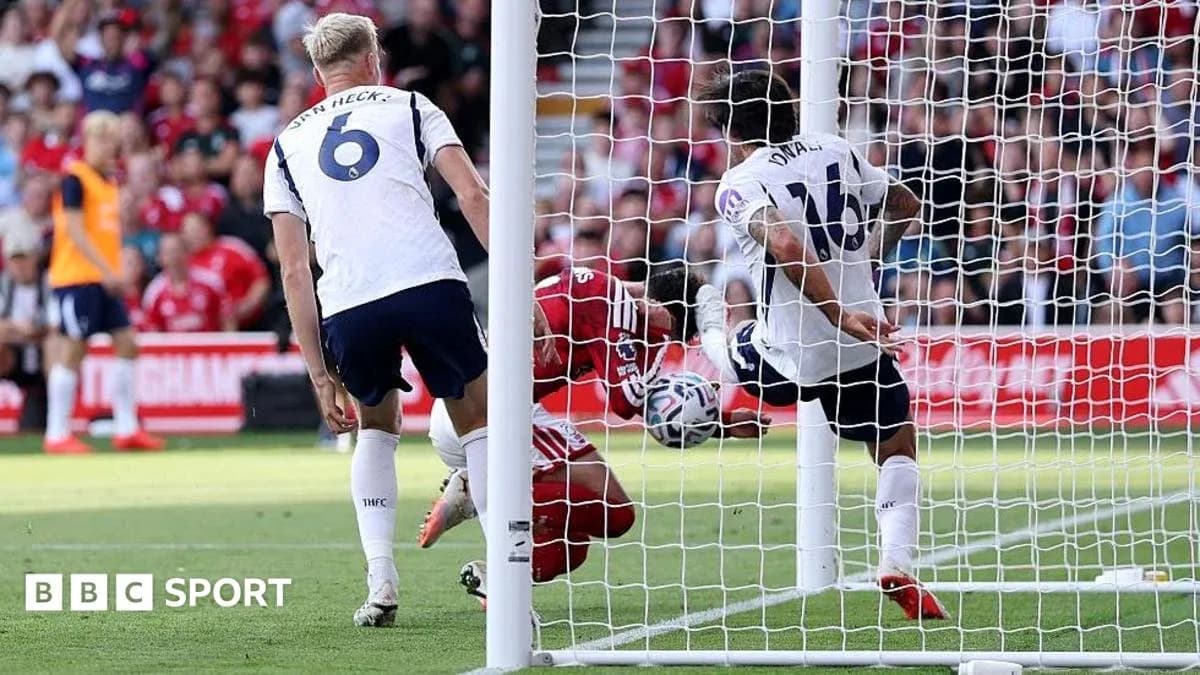
The ball did hit Neco Williams’ arm before his disallowed goal against Tottenham Hotspur. Twice.
New angle, old argument
In the 67th minute at the City Ground, Williams crashed the ball into the net and thought he had given Nottingham Forest a huge win. VAR Peter Bankes thought otherwise, ruling the goal out for accidental handball in the build-up.
Williams was furious. Oliver Glasner was certain. Both insisted there was no proof the ball had touched an arm.
Now there is.
A new camera angle, not available to the VAR team on the day, shows the ball first brushing Williams’ left arm and then his right forearm before crossing the line. It backs up Bankes’ decision. It will not calm the noise.
VAR vindicated – but with a catch
Inside the VAR hub, Bankes only had access to the broadcast cameras. The new angle comes from a camera that does not feed into live match coverage, one of several used for other production purposes.
On the footage he did see, Bankes believed the tell-tale sign came from the ripple of Williams’ shirt as the ball hit his right forearm. He was, according to those present, 100% convinced he had enough to rule the goal out.
The new clip supports that judgement. For Bankes, it’s vindication after two days of intense scrutiny.
For Forest fans, it changes little. Their anger is now less about whether the ball hit an arm, and more about whether the VAR had the right to step in at all.
Pro Ref stands firm
BBC Sport understands that Pro Ref – the rebranded refereeing body previously known as Professional Game Match Officials (PGMO) – is fully satisfied with the decision to disallow the goal.
Behind the scenes, there is irritation at how the story has snowballed. A big part of that stems from Williams’ post-match certainty that the ball never touched his arm, a claim now flatly contradicted by the new evidence.
"I've seen the images and the replays and at not one moment did I think I handballed it," Williams told Sky Sports.
"I have seen all the images and at not one moment can you tell that has clearly hit my arms, because it never. I knew straight away I've headed it down in between my arms. It didn't hit my arm."
The new footage shows something else: the ball does not touch his head at all. Given how fast the incident unfolded, it is entirely possible Williams genuinely believed he had headed it, but the pictures say otherwise.
The feeling within Pro Ref is simple: had Williams not been so emphatic, the backlash would not have been as fierce.
Nottingham Forest have been approached for comment.
‘Clear and obvious’? Not this time
A big chunk of the debate has revolved around that familiar phrase: “clear and obvious error”.
Glasner referenced it. Williams did too, in a post on X. The suggestion was that without conclusive proof, the VAR should have stayed out of it.
But that standard only applies to subjective calls – decisions that require the on-field referee to go to the pitchside monitor and re-referee an incident.
Attacking handball in the build-up to a goal is treated differently. It is classed as a factual offence. In those situations, the VAR does not need “clear and obvious” in the same sense; they need what they believe is proof. If they think they have it, the goal goes.
Bankes felt he had it. Many watching believed they could see the contact too. Others did not. And that is where the tension lives.
Because even these so-called factual interventions are, in reality, still rooted in judgement. One person’s certainty can be another’s doubt.
A law under pressure
There is a recent example that underlines the grey area. Benjamin Sesko’s goal for Manchester United against Liverpool last season appeared to show the ball possibly brushing the Slovenia striker’s fingertips before going in.
On that occasion, VAR Stuart Attwell let the goal stand. He did not feel he had conclusive proof of handball. Later, referees’ chief Howard Webb admitted the ball “probably does hit the hand” but stressed that “the VARs need to see that conclusively”.
Attwell did not. Bankes did. Same law, same technology, different reading.
Webb has already made clear he would like that law changed. During pre-season media briefings, he singled out attacking handball as one area he would rewrite, so that goals like Williams’ would not be ruled out on the kind of evidence available at the time.
"The problem is the law forces VARs on every goal to look at what body part the ball went in off," Webb said.
"If you were only to penalise when the attacker deliberately handles the ball or makes himself unjustifiably big – and not have that forensic examination – you could 'check complete' it more quickly.
"It is a law I would definitely look to change. So Pro Ref and the Premier League are going to try and lobby for that to be changed."
The irony is stark. Under the kind of law Webb wants, Williams’ goal might well have stood.
Lighter touch, heavy fallout
VAR is officially being used with a lighter touch this season. The numbers back that up: just two subjective interventions so far, at a rate of 0.06 per game, down from 0.15 last season.
That has not softened the mood around it.
Every major call still lands in a storm of tribal anger and slow-motion replays, each clip pored over, each frame weaponised. This incident is no different: one disallowed goal, one correct call by the letter of the law, one new angle that changes the conversation – and yet leaves nobody truly satisfied.
The technology has done its job. The law has been applied. The arguments are only getting louder.