.svg&w=384&q=75 "Naijagoal logo")
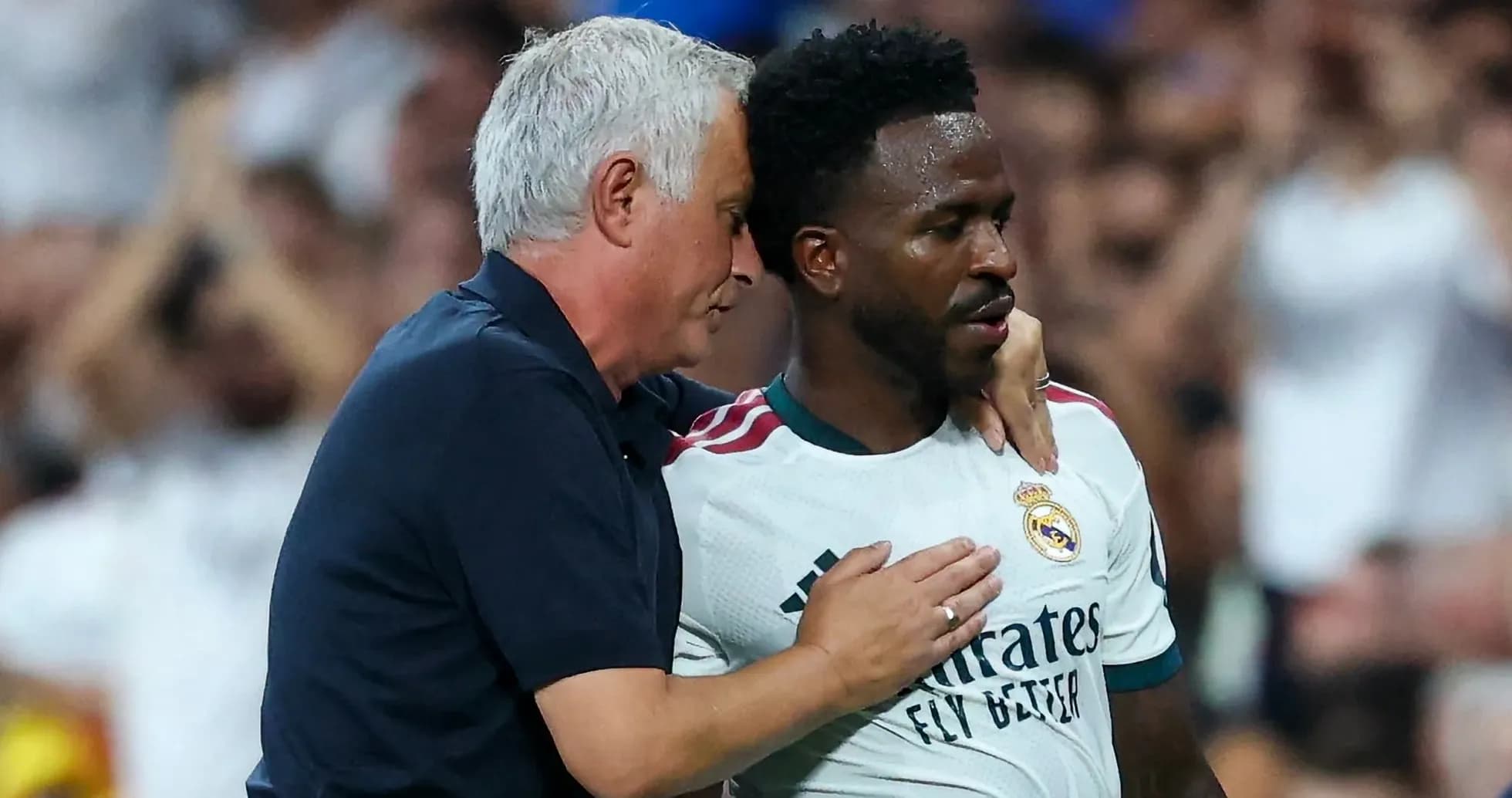

Mourinho Defends Vinicius Amid Struggles
Jose Mourinho did not try to disguise it. Vinicius is off his game.
But as he faced the media after the final whistle, the Real Madrid coach drew a sharp line between form and effort, defending a winger he believes is running himself into the ground for the team.
“He isn't at his best, and he knows it,” Mourinho admitted. “But he's working hard to be the Vinicius who decides games. Without being at his best, he's working harder than ever.”
Mourinho backs a tired Vinicius
This was not the explosive Vinicius who tears full-backs apart and settles nights on his own. Against Inter, the Brazilian often found himself chasing back, doubling up, and then lacking the spark to punish defenders when the ball finally came his way.
For Mourinho, that was not a lack of commitment. It was the cost of it.
“In the moments that he wasn't able to drop back and defend, it was because of fatigue,” he said. “I have to value that a lot. I have a lot of respect for this Vinicius. The time will come when he decides games, and wins us games.”
The message was clear: the goals and assists can wait, the work cannot.
This comes at a delicate time for the forward. After a turbulent 2025-26 season, marked by criticism from sections of the Madrid support, Vinicius chose to commit his long-term future to the club in the summer. The new campaign was supposed to be a reset, a statement.
So far, the numbers are modest by his standards: one goal and two assists in five appearances. Not disastrous, but not the devastating output Madrid have come to demand from their No. 7.
Tactical grind against Inter
Mourinho pointed to the context. Inter’s back three and aggressive wing-backs turned the flanks into a tactical minefield, forcing Vinicius into a physically draining shift without the usual reward.
“If he works, he'll always have my support,” Mourinho insisted. “He worked very hard for the team. Playing against a side that plays with three at the back, with wing-backs, it's very hard for the wingers.
“Obviously with the one-on-ones he had on the left wing, with Vini at his best, he'd kill the game. That's what we expect of him. But he gave everything.”
The implication was brutal but honest: the chances were there, a peak Vinicius finishes the job. This version, still searching for rhythm, could not.
Makeshift Madrid and Trent’s sacrifice
The night also exposed deeper structural problems for Madrid. Suspensions to Bernardo Silva, Arda Guler and Eduardo Camavinga ripped the heart out of Mourinho’s midfield options and forced him into a bold, awkward solution: Trent Alexander-Arnold in central midfield.
The England international has flirted with the role for club and country, but this was a different ask in a high-stakes, high-intensity contest.
“It's hard for Trent,” Mourinho said. “I appreciate the effort he made, but with his characteristics, the specificity needed to play full-back or central midfield, it's completely different physically.
“He had some losses of the ball, because it's not the same playing with the whole field in front of you, and playing with half the field behind you. He's played there a few times with Liverpool and the national team, but it's completely different. He didn't have more to give.”
It was as much a defence of the player as an admission of the gamble. A full-back asked to think like a midfielder, a winger asked to be a full-back, a team stretched by absences and a demanding opponent.
For now, Mourinho is betting that the heavy legs of September will give way to the sharp edge Madrid need. The question is how long a club of this size, and a fanbase of this impatience, will wait for Vinicius to become the man who “kills the game” again.