.svg&w=384&q=75 "Naijagoal logo")
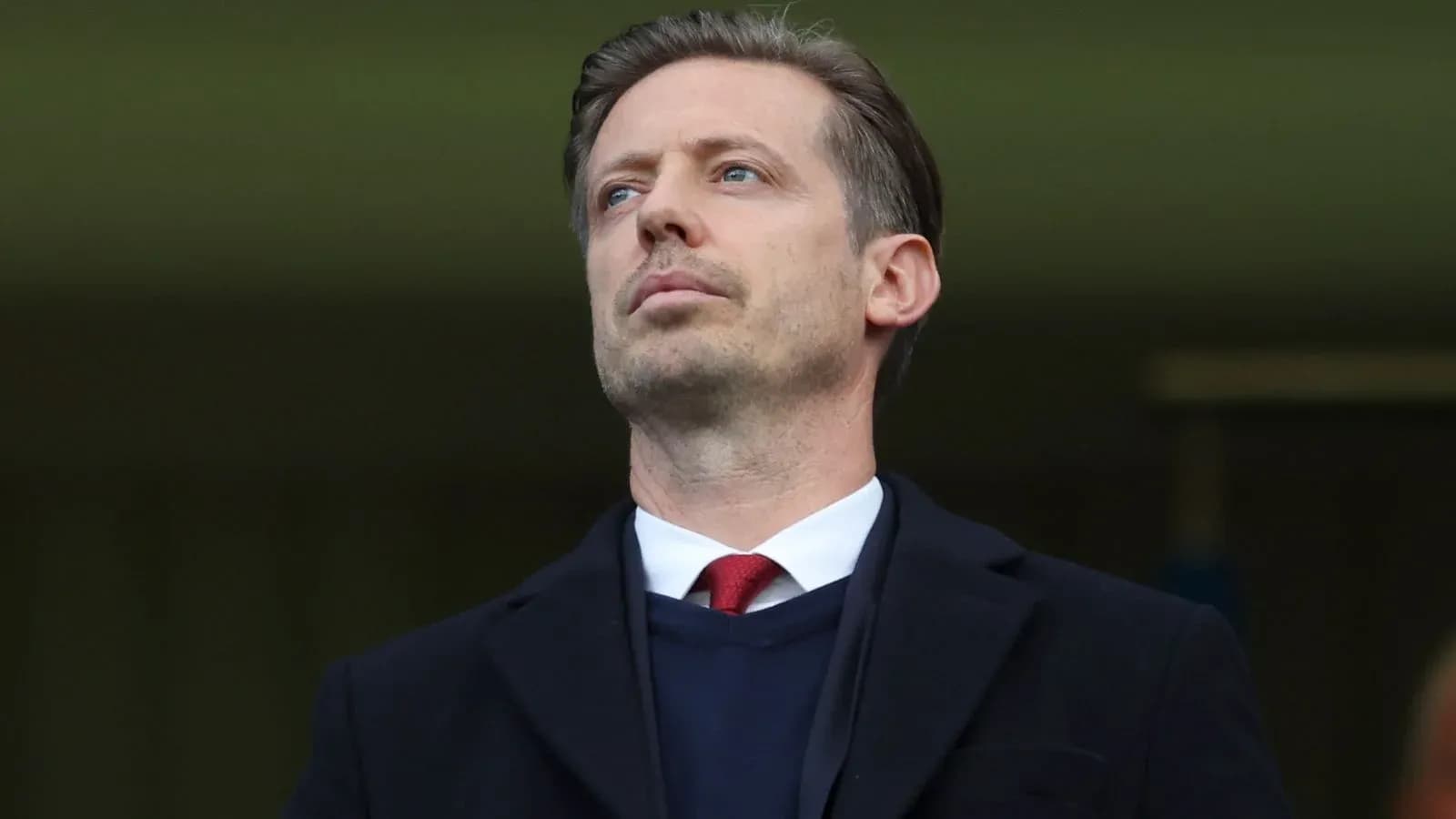

Michael Edwards Leaves Liverpool: A New Chapter Begins
Michael Edwards’ second Liverpool era is over. The architect of one of the club’s great modern rebuilds is stepping away again, this time as Fenway Sports Group’s CEO of football, just as another turbulent chapter begins at Anfield.
FSG insist this is no rupture. In their words, it is a “planned transition”, the end point of a process mapped out when Edwards returned to the organisation in March 2024. But the timing is striking. Liverpool are heading into the 2026/27 season with a new head coach, a looming rebuild, and the small matter of replacing Mohamed Salah.
The end of a second act
Edwards’ relationship with Liverpool has framed much of the club’s recent history. He first arrived in 2011, initially as performance director, then rose to sporting director in 2016. From that vantage point he helped shape a title-winning squad, recruiting the core that delivered the 2019/20 Premier League – Liverpool’s first league crown since 1990.
He left in 2022 with his reputation burnished, the quiet deal-maker behind a modern powerhouse. When he reappeared two years later, it was in a new role and under very different circumstances.
By March 2024, Jürgen Klopp had announced his departure, the club braced for emotional and structural upheaval. Edwards returned as FSG’s CEO of football, charged with overseeing all football operations at Liverpool and helping ownership plot a wider multi-club strategy.
According to FSG, he delivered on the brief they gave him.
“Since returning to the organisation in March 2024, he has helped oversee Liverpool through a significant period of change,” their statement read, highlighting the “implementation of a new football leadership structure and the appointment of a new head coach.”
He also presided over a landmark moment: Liverpool’s historic 20th English league title, secured in 2025 under Arne Slot. The club’s evolution, on and off the pitch, seemed to be following a carefully drawn blueprint.
Titles, turbulence and a changing hierarchy
The story since that 20th title has been anything but straightforward.
Slot arrived in June 2024, inheriting the post-Klopp landscape and, for a time, maintaining Liverpool’s place at the top of English football. The 2025 triumph pushed the club level with Manchester United’s tally of league titles and underlined the sense of continuity after Klopp.
Then the momentum stalled. A below-par second season cost Slot his job, and by early June he had been replaced by Andoni Iraola. Another head coach. Another reset.
Edwards leaves against this backdrop of churn. FSG describe his exit as the “culmination of a planned transition following the completion of key strategic priorities” and point to the groundwork laid for “the next phase” of Liverpool’s development.
He has, they say, done what he came back to do.
Edwards’ own verdict
In his parting words, Edwards sounded more reflective than triumphant.
“It has been a privilege to return to Fenway Sports Group and Liverpool Football Club at such an important moment,” he said, stressing that he departs believing the club is “in a strong position, with outstanding people, a clear direction and the foundations in place for continued success.”
His remit extended beyond Anfield. FSG had tasked him with helping shape their broader football ambitions, a project that, by his own admission, did not quite follow the original script.
“While that broader project ultimately evolved differently to how we had originally envisaged,” he said, “I am proud of the work our team undertook in presenting ownership with a broad range of thoughtful and well-developed options for the future.”
The goodbye was completed with familiar notes of gratitude, as he thanked Mike Gordon, John W. Henry, Tom Werner, staff across FSG and Liverpool, and, pointedly, the supporters “whose passion makes this club so special.”
“I will always be grateful to have been part of its story,” he concluded.
Big decisions, big gaps
Now comes the hard part for those left behind.
Edwards’ departure lands just as Liverpool approach a pivotal summer window. Replacing Mohamed Salah – or at the very least planning for life without the club’s defining forward of the past decade – is one of the most complex tasks any recruitment department could face.
On top of that, the hierarchy itself may not be settled. There is speculation that sporting director Richard Hughes could also move on, a possibility that would deepen the sense of flux in the corridors of power.
For years, Liverpool’s strength rested on clarity: a coherent structure, aligned decision-makers, a long-term vision. Edwards was central to that. His fingerprints are on the squad that ended the 30-year title wait and on the systems that underpinned Liverpool’s resurgence.
Now, as he steps away once more, Liverpool must prove that the framework he helped build can outlast the man who designed so much of it.
The next transfer window, and the search for the next Salah, will reveal just how sturdy those foundations really are.