.svg&w=384&q=75 "Naijagoal logo")
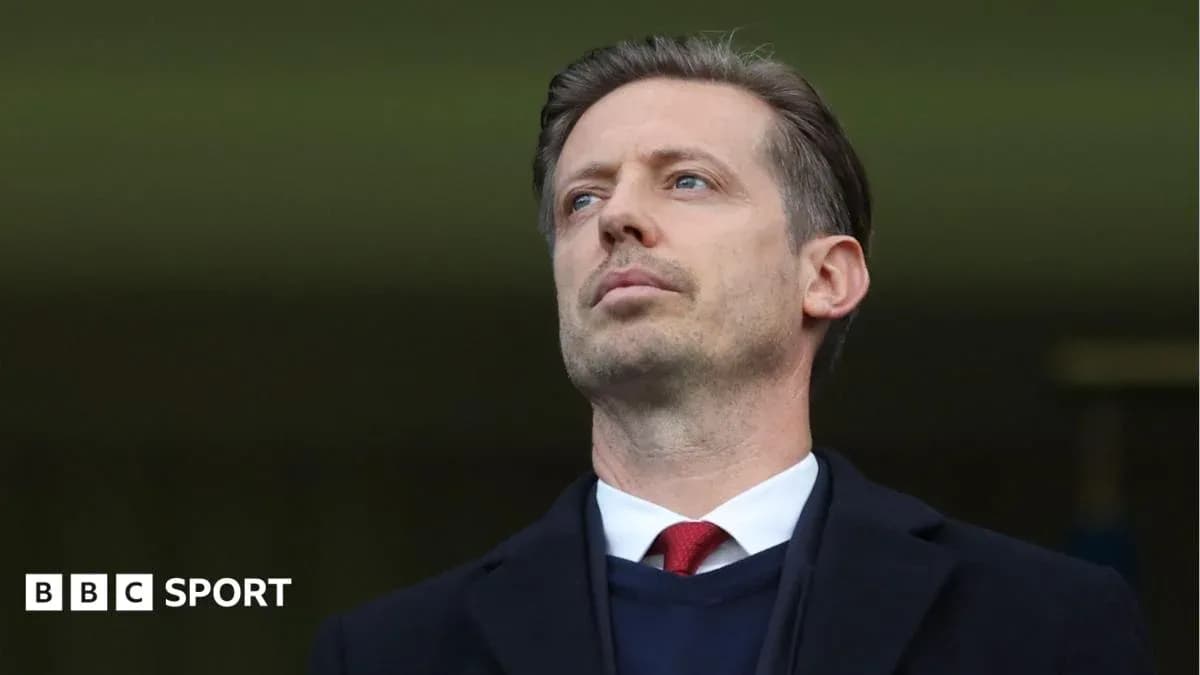

Michael Edwards Leaves FSG Role as Liverpool Faces Critical Transition
Michael Edwards, the architect of much of Liverpool’s modern resurgence, has stepped away once again. This time, it is from the boardroom rather than the recruitment bunker.
Fenway Sports Group confirmed that Edwards has left his position as chief executive of football, describing the move as part of a “planned transition following the completion of key strategic priorities”. The language is tidy, corporate, controlled. The timing is anything but straightforward.
Edwards departs two years into a three-year contract, having returned to work closely with Liverpool in March 2024. His brief then was clear: guide the club through the end of the Jurgen Klopp era and help shape FSG’s broader football ambitions. The first part has been navigated. The second, by Edwards’ own admission, has taken a different turn.
“Liverpool is in a strong position, with outstanding people, a clear direction and the foundations in place for continued success,” he said in a statement, framing his exit as a handover rather than a rupture. He spoke of the excitement of returning, of the chance “to help guide Liverpool through an important period of transition” and to influence FSG’s wider plans. That grander project, he conceded, “ultimately evolved differently to how we had originally envisaged”.
Those words matter. They hint at a divergence between vision and reality at ownership level, even as FSG president Mike Gordon insisted the group is “naturally disappointed” to see him go.
The club he leaves behind stands on the brink of another rebuild. Klopp has gone. The dressing room has already begun to shift. Now the man trusted to steer the strategy from above has stepped away again.
And there is the looming void on the pitch. Mohamed Salah, the defining forward of the Klopp era and the face of Liverpool’s revival, left at the end of last season. Replacing him is not just a transfer problem; it is a cultural one. Salah’s goals, his durability, his aura – they have underpinned almost everything Liverpool have done since he arrived.
Finding the next version of that influence, or finding a new way to win without it, will be one of the defining tasks of the coming campaign. It will have to be done without the man whose transfer work once set the standard.
Speculation is already swirling around sporting director Richard Hughes. His future is under scrutiny before he has truly had time to settle. If he follows Edwards through the exit door, Liverpool’s carefully constructed football structure will look far less secure than the public messaging suggests.
Edwards’ legacy at Anfield is not built on job titles but on decisions. He first joined the club in 2011 and rose to sporting director in 2016, leaving in the summer of 2022 with a reputation as one of the sharpest operators in the game. That reputation was earned, not gifted.
Under his watch, Liverpool recruited Salah, Roberto Firmino, Sadio Mane, Andy Robertson and Virgil van Dijk – a spine that dragged the club from nearly-men to champions. Those signings turned promise into a Premier League title in 2020, ending a 30-year wait for the top-flight crown. They also delivered a Champions League, a Club World Cup and a sense that Liverpool had finally cracked the code of modern recruitment.
Now, the man who once built the project and then briefly returned to safeguard its future has gone again, this time from the ownership side. The foundations he talks about are real: a strong squad, a clear playing identity, a club accustomed to competing at the top.
But foundations are only as valuable as the next decisions made on top of them. With Salah gone, Klopp gone and Edwards out of the inner circle, Liverpool and FSG have reached another defining moment. The question is no longer what Edwards can build for them.
It is what they can build without him.