.svg&w=384&q=75 "Naijagoal logo")

Mexico's Tactical Masterclass Against Ecuador: A 2-0 Victory
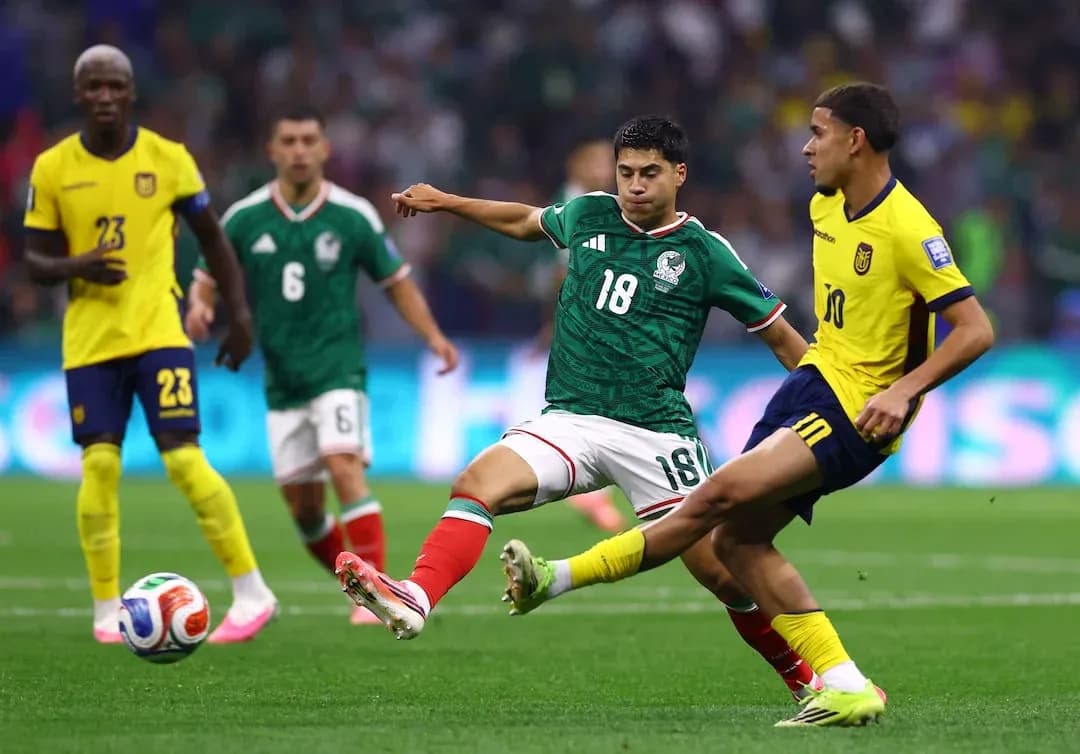
Mexico’s 2-0 win over Ecuador at Estadio Banorte in this World Cup Round of 32 tie was a classic example of a team controlling the game without the ball. Javier Aguirre’s 4-3-3 delivered an early two-goal punch and then managed the space and rhythm expertly, while Sebastian Beccacece’s 4-4-2 Ecuador side had more of the ball (57% possession) but rarely turned circulation into clear chances, finishing with just one shot on target and a late red card.
Executive Summary
Mexico combined vertical efficiency with compact defending. They generated 15 total shots to Ecuador’s 7 despite having only 43% of the ball, and went into half-time 2-0 up, a lead they never looked likely to surrender. The front three’s interchanges and the midfield’s aggressive pressing traps were decisive in the first half; after the break, Mexico flattened the game, accepting Ecuador’s sterile dominance and protecting central zones. Discipline issues undermined Ecuador’s late push, with three yellow cards and one red as frustration grew in added time.
Scoring Sequence & Disciplinary Log
The breakthrough came on 22': Julián Quiñones finished for Mexico, assisted by Roberto Alvarado, capping a direct, well-timed attacking pattern that exploited Ecuador’s back line before it could settle. On 31', Raúl Jiménez doubled the lead, this time assisted by Quiñones, underlining the fluid relationship between Mexico’s central striker and left-sided forward. Those two actions defined the scoreboard and allowed Mexico to dictate the match state thereafter.
All cards went to Ecuador and came in a tight late-game cluster, reflecting rising frustration rather than tactical fouling earlier on:
- 45+1' Alan Franco (Ecuador) — Tripping
- 90+3' Kendry Páez (Ecuador) — Tripping
- 90+5' Piero Hincapié (Ecuador) — Unsportsmanlike conduct (Red Card)
- 90+9' Moisés Caicedo (Ecuador) — Tripping
The chronology matters: Ecuador’s only first-half card, to Franco, arrived just before the interval; the remaining disciplinary incidents all occurred in stoppage time of the second half, by which point the contest’s tactical narrative was set and Ecuador were chasing increasingly desperately.
Tactical Breakdown & Personnel
Mexico lined up in a 4-3-3 with Raúl Rangel in goal, Jorge Sánchez and Jesús Gallardo as full-backs, and César Montes with Johan Vásquez as the central pairing. In midfield, Gilberto Mora, Erik Lira and Luis Romo formed a narrow trio, supporting a front line of Roberto Alvarado (right), Jiménez (central) and Quiñones (left).
Out of possession, Mexico’s structure resembled a 4-1-4-1 or 4-5-1 depending on the height of the wingers. Lira often held the deepest midfield line, screening passes into Enner Valencia and Gonzalo Plata, while Mora and Romo stepped aggressively onto Ecuador’s double pivot, especially Moisés Caicedo. This compactness forced Ecuador wide and limited their ability to combine centrally; it is telling that Ecuador produced just 7 total shots, with only 5 from inside the box and a single effort on target.
With the ball, Mexico were vertical and selective. Their 319 passes (249 accurate, 78%) were fewer than Ecuador’s 407 (340 accurate, 84%), but they translated possession into more threatening situations: 15 total shots, 10 from inside the box, and an xG of 1.02. The front three were key: Quiñones drifted inside from the left to combine with Jiménez, while Alvarado provided width and the final ball from the right. The first goal encapsulated this pattern, with Alvarado supplying the assist to Quiñones; the second flipped the roles, Jiménez finishing from a Quiñones pass.
Substitutions from Aguirre were clearly game-state driven. At 58', Brian Gutiérrez (IN) came on for Gilberto Mora (OUT), adding fresh legs and energy in midfield to maintain the pressing intensity. At 73', Obed Vargas (IN) came on for Luis Romo (OUT), further reinforcing central stability. The 74' change, with Santiago Giménez (IN) for Jiménez (OUT), preserved the ability to hold the ball up and run channels without sacrificing defensive work rate. At 80', Orbelín Pineda (IN) came on for Quiñones (OUT), and Israel Reyes (IN) for Alvarado (OUT), effectively shifting Mexico towards a more conservative, control-oriented shape with extra defensive security on the flank.
Ecuador’s 4-4-2, with Hernán Galíndez in goal, Alan Franco and Piero Hincapié at full-back, and Joel Ordóñez with Willian Pacho centrally, struggled to cope with Mexico’s early tempo. John Yeboah and Nilson Angulo started wide, with Caicedo and Pedro Vite inside, supporting Valencia and Plata up front. However, the double substitution at 46' — Yaimar Medina (IN) for Franco (OUT) and Ángelo Preciado (IN) for Ordóñez (OUT) — indicated Beccacece’s dissatisfaction with the defensive balance and build-up lanes.
Later attacking changes — Kevin Rodriguez (IN) for Enner Valencia (OUT) at 59', Jordy Caicedo (IN) for John Yeboah (OUT) and Kendry Páez (IN) for Nilson Angulo (OUT) both at 79' — pushed Ecuador towards a more aggressive, multi-forward configuration. Yet the underlying problem remained: Mexico’s block denied central progression, and Ecuador’s increased possession did not translate into quality chances, reflected in an xG of 0.73 and just one shot on target.
In goal, Raúl Rangel (Mexico) made 1 save. That low number underscores how well-protected he was by the defensive structure rather than indicating passivity. Hernán Galíndez (Ecuador) also made 1 save, but with Mexico scoring twice from three shots on goal and Ecuador’s goals prevented value at -0.57, his night reflected a combination of clinical Mexican finishing and slightly under-par shot-stopping relative to expectation.
The Statistical Verdict
The raw numbers reinforce the tactical story. Ecuador’s 57% possession and higher passing volume (407 passes, 340 accurate, 84%) point to territorial control, but their attacking output — 7 shots, 1 on goal, xG 0.73, and only 1 blocked shot — shows that Mexico successfully funneled them into low-yield areas. Mexico, with 43% possession and 319 passes (249 accurate, 78%), generated 15 shots, 3 on goal, 3 blocked, and 10 from inside the box, converting an xG of 1.02 into two first-half goals.
Discipline was lopsided: Mexico committed 10 fouls with no cards, while Ecuador’s 14 fouls produced 3 yellow cards and 1 red card, all on Ecuadorian players and three of them in stoppage time. Corner kicks (Mexico 3, Ecuador 8) again highlight Ecuador’s territorial advantage but also Mexico’s comfort defending set pieces and crosses.
In the context of tournament knockout football, this performance profiles Mexico as a side capable of executing a pragmatic, low-possession game plan with high efficiency in both boxes, while Ecuador’s numbers suggest a team that can dominate phases of play but must sharpen its chance creation and maintain composure under scoreboard pressure.