.svg&w=384&q=75 "Naijagoal logo")

Manchester United's Left-Back Dilemma: A Risky Gamble
As the clock struck 23:00 BST on 1 September and the window slammed shut, a single question hung over Manchester United’s summer like low cloud over Old Trafford.
What about a left-back?
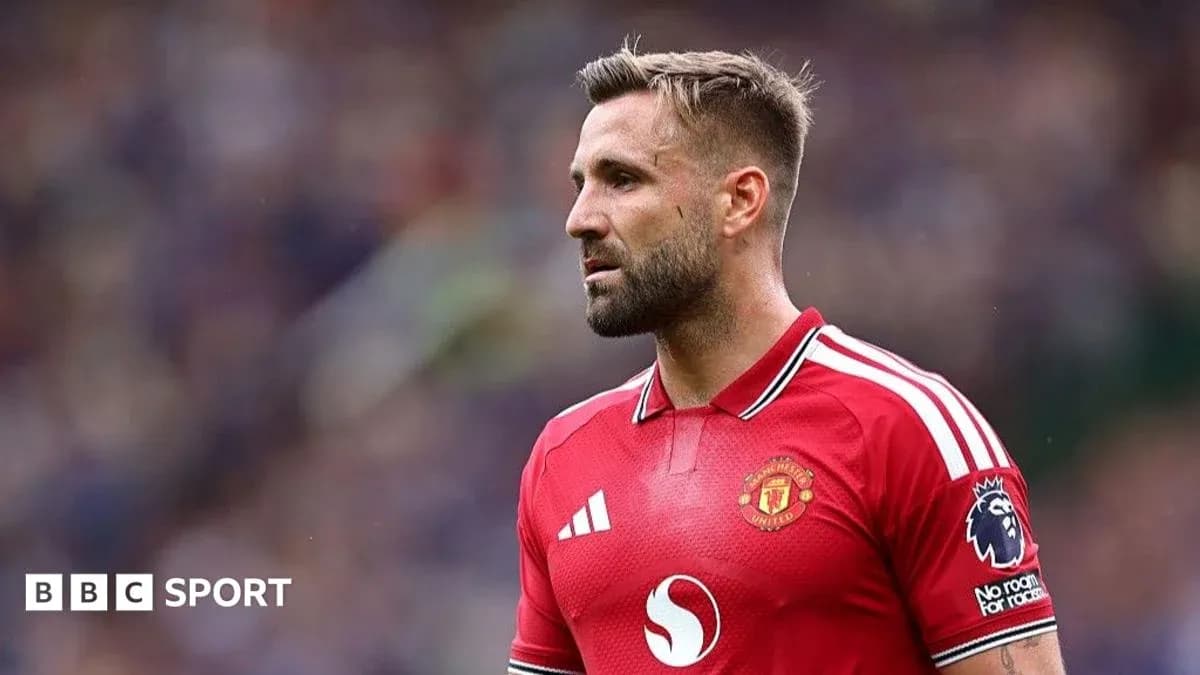
All summer, as arguments raged over Michael Carrick’s priorities and the club’s evolving transfer strategy, one weakness in the squad seemed so obvious it barely needed saying. Luke Shaw stood alone as the only senior, natural left-back. He had somehow started all 38 Premier League games last season – an ironman effort given his injury history – but nobody inside or outside the club believes a 31-year-old can be run through another campaign that might stretch beyond 60 matches.
Tyrell Malacia’s departure at the end of June, when his contract expired, only sharpened the focus. Back-up gone. Schedule brutal. Logic pointed in one direction: United would bring in cover.
They didn’t.
Targets were lined up and ticked off. Lewis Hall at Newcastle. Alejandro Balde at Barcelona. Jorge Salinas at Racing Santander. The shortlist was real, the conversations serious. In the end, the late push was for Rayan Ait-Nouri, a bold attempt to prise him across Manchester on loan. City blocked it. For that deal to move, United would have had to accept an obligation to buy further down the line. They chose not to. They chose to wait for what they see as first-choice options.
Now the deadline has gone, and the gamble is locked in until January.
The one that got away – for now
Inside Old Trafford, there’s no secret: Manchester United really like Lewis Hall.
If they could have done a deal with Newcastle, they would have. But the reality of the market bit hard. Newcastle, already stripped of key players by Premier League rivals this summer, made it clear that prising away their highly rated 22-year-old would require a huge fee.
United’s budget was not bottomless. Faced with that financial wall, the club doubled down on what they had already labelled the ‘priority’ area – midfield. That is where the money went, £70m committed to bring Carlos Baleba from Brighton.
The conclusion was simple, if not universally popular: Hall is a player they are prepared to wait for until next summer.
Balde was a different story. United were open to a loan. Barcelona were not. They wanted a sale. Salinas, with a relatively low release clause, looked attainable on paper, but Atletico Madrid always led that race. By the time United’s attention flicked to Argentina defender Nicolas Tagliafico – and they missed out on him as well – the club had already started to move away from the idea of a straightforward left-back signing.
The late return to Ait-Nouri, prompted by an agent’s approach, was telling. It was a tacit admission that, even inside Carrick’s staff, there isn’t complete conviction about the path chosen.
Shaw, makeshift cover and a mystery prospect
Strip it all back and the plan looks like this: Shaw remains first-choice. Behind him, Noussair Mazraoui is viewed as the primary back-up option on that flank, a role he knows from international duty with Morocco. Diogo Dalot, who has switched sides before, offers further insurance. Then comes Harry Amass.
And that is where the story takes a strange turn.
Amass is a natural left-back, a product of United’s academy. He impressed on loan at Sheffield Wednesday last season, then saw that momentum stall when he picked up an injury shortly after moving to Norwich in the winter window. At 19, he re-emerged this pre-season, shadowing Shaw and catching the eye with composed, confident performances.
Yet for much of the summer, United were prepared to let him go.
The doubts around Amass are not new. Back in 2024, Erik ten Hag left him out of the Community Shield squad, even though the teenager had handled himself well against Mo Salah in a pre-season game in the United States just a week earlier. Ten Hag’s view was blunt: physically, Amass was not yet at the required level.
Two years on, logic suggests he should be stronger, more robust, more ready. Interest in him has been constant. As deadline day approached, his absence from United’s Premier League 2 game against Leicester on Monday seemed to confirm the expectation he would leave, most likely on loan.
He didn’t. The window closed. Amass stayed.
Now, nobody is quite sure what his role will be in Carrick’s senior set-up. Breakthrough prospect? Emergency cover? Training-ground extra? For a club that has spent the summer stressing the importance of clear planning, the situation feels oddly unresolved.
Yoro’s switch and the bigger bet
The willingness to lean on Mazraoui as a left-back is tied directly to another experiment: Leny Yoro at right-back.
Signed from Lille in 2024 for £52m as a central defender, Yoro spent most of this pre-season stationed on the right. Against Ipswich on Sunday, Carrick repeated the pattern. Dalot went off, Yoro came on at right-back. At the same moment, Mazraoui replaced Shaw on the opposite flank.
Yoro is only 20. He is still learning the angles, the timing, the demands of full-back play. But he has tools that coaches crave – pace, strength, comfort on the ball. United fans only need to glance across the city to see a template: Josko Gvardiol, signed by Manchester City as a central defender, now thriving as a full-back.
That is the sort of positional evolution United are banking on. If Yoro adapts, Mazraoui can swing across. If Mazraoui holds his own at left-back, Dalot can shuffle where needed. If Shaw stays fit, the whole structure holds.
It is a web of ifs. A calculated risk, as the club freely admit.
Lessons from past mistakes
One thing United were determined not to repeat was the scattergun thinking that led to previous full-back signings. Internally, Alex Telles, Matteo Darmian and Sergio Reguilon are now cautionary tales – players brought in to plug gaps, but who never truly hit the level required.
This summer, the club took a hard line on valuations. They refused to be dragged into panic buying or overpaying for anyone they did not see as a long-term solution. No late splurges. No short-term fixes just to quieten the noise.
On paper, the logic holds. Protect the budget. Avoid another misfit. Trust the structure of the squad and the flexibility of players like Mazraoui, Dalot and Yoro. Keep the powder dry for Hall or another top-tier left-back next summer.
From a distance, it probably is the right call.
But football is not lived at a distance. It is lived in the heat of a title race, in the panic of an injury crisis, in the cold dread when Shaw pulls up holding a hamstring in December and the fixture list stretches on and on.
United have chosen their risk. Over the next few months, the Premier League will decide whether it was bravery or folly.