.svg&w=384&q=75 "Naijagoal logo")
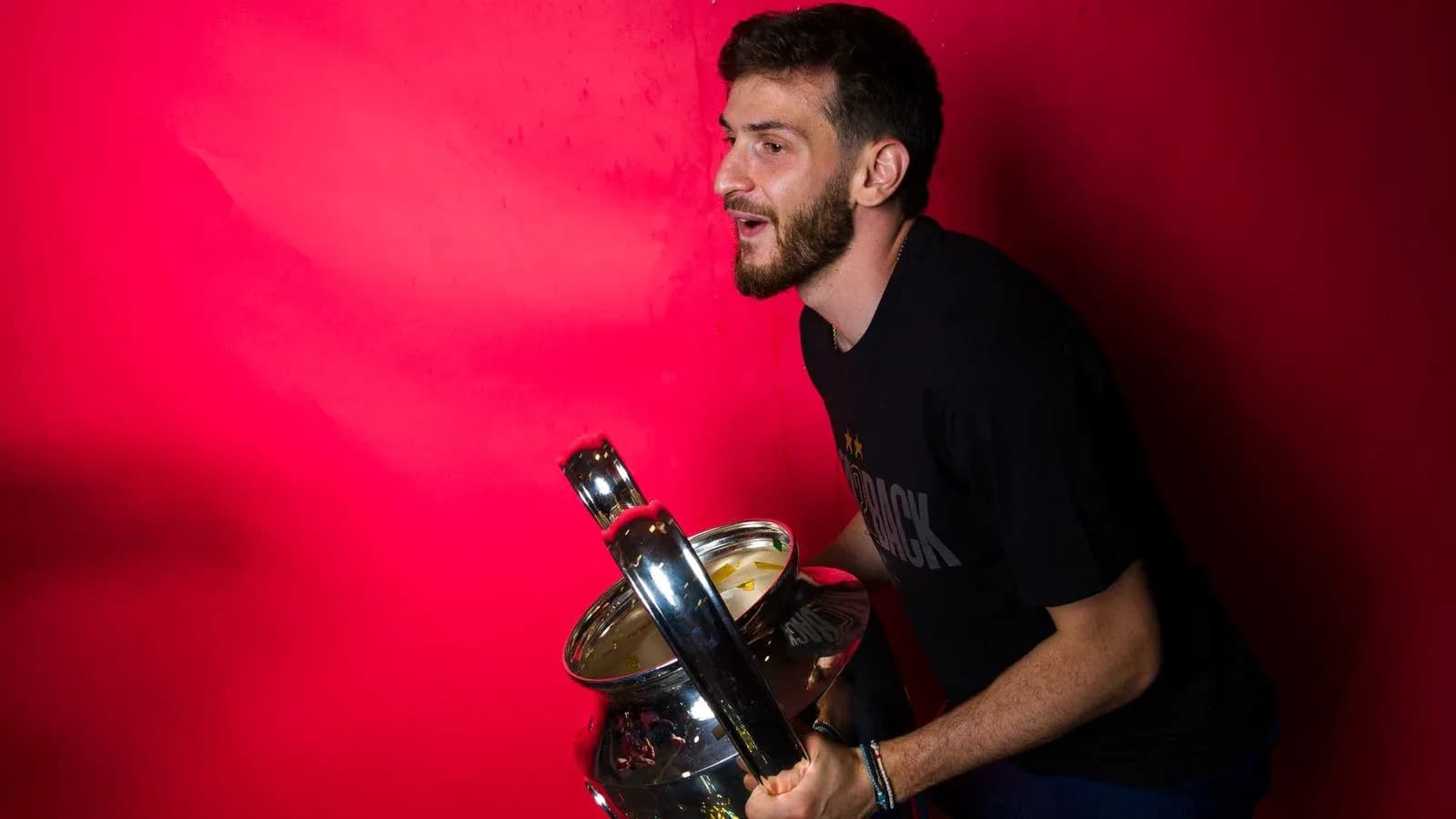

Khvicha Kvaratskhelia: PSG’s Unstoppable Force in the Super Cup
The World Cup was billed as the tournament where every superstar finally had their stage. Many of them delivered. The summer belonged to the familiar faces.
But as the club game resumes with the UEFA Super Cup in Salzburg, the lights swing back to a man who watched that global showpiece from afar. Khvicha Kvaratskhelia returns, and he is coming for his spotlight.
PSG’s unlikely centrepiece
At 25, Kvaratskhelia arrives in Austria as the reigning Champions League player of the season, the driving force behind Paris Saint-Germain’s successful defence of their crown in May. He is chasing a threepeat now, eager to remind everyone that one of Europe’s truly elite performers never set foot on the World Cup stage.
Others at PSG have collected their own honours in this era of dominance. Marquinhos has lifted the Champions League trophy twice in Paris colours. Desire Doue and Vitinha walked away with man-of-the-match awards in the finals in Munich and Budapest. Ousmane Dembele claimed the Ballon d'Or after that first historic European triumph.
Yet the story of this PSG, the version that has begun to bully the continent, really started with one signing.
Kvaratskhelia arrived from Napoli in January last year and changed the temperature of the entire club. Before him, PSG’s European campaigns had felt strangely flat, as if a crucial piece of the puzzle had gone missing.
Once he walked through the door, that feeling vanished.
Luis Enrique suddenly had a forward who embodied his demands. Kvaratskhelia turned PSG into a snarling, relentless pressing unit from the front. He hunted, he harried, he ran. The effect spread. Standards in the forward line shifted. Players who had coasted at times now chased, tackled, and tracked. The tone was different.
Villa know the damage he can do
Aston Villa, PSG’s opponents in this season’s Super Cup, do not need a scouting report to understand the threat.
They have already felt it.
In the first leg of their 2025 Champions League quarter-final, it was Kvaratskhelia’s quick feet and sharp changes of direction that shredded Axel Disasi. That tie proved to be PSG’s sternest test in the knockout rounds, and in the most hostile moments, it was the Georgian winger who kept dragging them forward.
The pressure he applied in that run only grew last season. From the play-off round onwards, no player scored more goals in the Champions League. Nobody created more assists from open play either. When the competition narrowed, when the margin for error disappeared, he raised his level again.
The body of work is starting to look imposing.
From ‘Kvaradona’ to Parisian talisman
Long before Paris, Kvaratskhelia had already rewritten history in Naples. He spearheaded Napoli’s title win, ending a wait so long it had grown mythical, the kind of drought many believed only Diego Maradona could break. That is where the ‘Kvaradona’ nickname was born, a nod to the scale of his impact rather than a lazy comparison.
What makes him so compelling is how singular he feels. He is an outlier. There is no obvious template for him, no easy comparison in the modern game, either in how he plays or how he emerged.
Many of his current team-mates in Paris are products of a finely tuned French system, the latest graduates from academies designed to churn out elite talent. In England, a similar overhaul of youth structures, combined with the financial and competitive pull of the Premier League, has created conveyor belts of young stars.
Kvaratskhelia came through a different world.
Leonid Slutsky, his coach at Rubin Kazan, captured it neatly back in 2023. “Nobody knew about him before he came to Italy and that is understandable,” he said at the time. Slutsky described his “abnormal thinking” on the pitch, the instinct to see and attempt things others would never even consider. Then came the line that stuck: “I congratulate Napoli because they won the lottery.”
Xisco Munoz, who played and coached at Dinamo Tbilisi, traced those instincts back to Georgia itself. “In Spain, we stop and pass, maybe learning on a training ground or at school,” he told Sky Sports. “In Georgia, it is street talent. In Georgia, they play their football on the street. They have to fight and have the contact. It is difficult to teach this in school.”
That street edge shows in his game. The dribbles that look improvised, the angles that seem to appear only to him, the refusal to play safe when the game is on the line.
Obsession, sacrifice and a missed World Cup
Behind the flair sits a ruthless work ethic. David Webb, who worked with him at international level, remembers a player who simply would not leave the training ground. “He is very process-driven,” Webb recalled. “It is not something that he does for effect. He has done it since day one.”
That obsession has carried a cost.
Georgia’s failure to qualify for the World Cup this summer cut him out of the game’s grandest stage. For his body, it might have been a blessing. After hauling his country to Euro 2024 and then featuring at the Club World Cup last year, this was his first real window to rest and reset in years.
For his Ballon d'Or prospects, though, the timing could hurt.
History does offer a sliver of hope. Kevin Keegan won the award in a World Cup year without England even reaching the tournament, but that was a very different era, when only European players were eligible and Argentina had just lifted the trophy.
Now, Kvaratskhelia must battle not only perception but a crowded field. Spain’s World Cup winners bring their own powerful cases. Kylian Mbappe and Harry Kane continue to stack up outrageous scoring numbers for club and country. The narrative weight of a World Cup still matters.
Which is why Salzburg matters too.
Super Cup as a statement
The Super Cup will not decide the Ballon d'Or. It will not settle the argument over who the best player in Europe is. But it offers a stage, and right now, Kvaratskhelia is in the kind of form that can turn any stage into his own.
He remains the man who both decorates and drives the performances of what is, at this moment, the strongest team in Europe. The tricks and feints are not showreel fodder; they are weapons, used to break presses, open games, and tilt ties.
Khvicha Kvaratskhelia, last season’s outstanding player in the Champions League and PSG’s warrior on the wing, steps into another final with fresh legs, a clear mind, and a point still to prove.
The World Cup went on without him. The club game will not ignore him so easily.