.svg&w=384&q=75 "Naijagoal logo")

Jagiellonia's Tactical Victory Over Rangers in UEFA Europa League
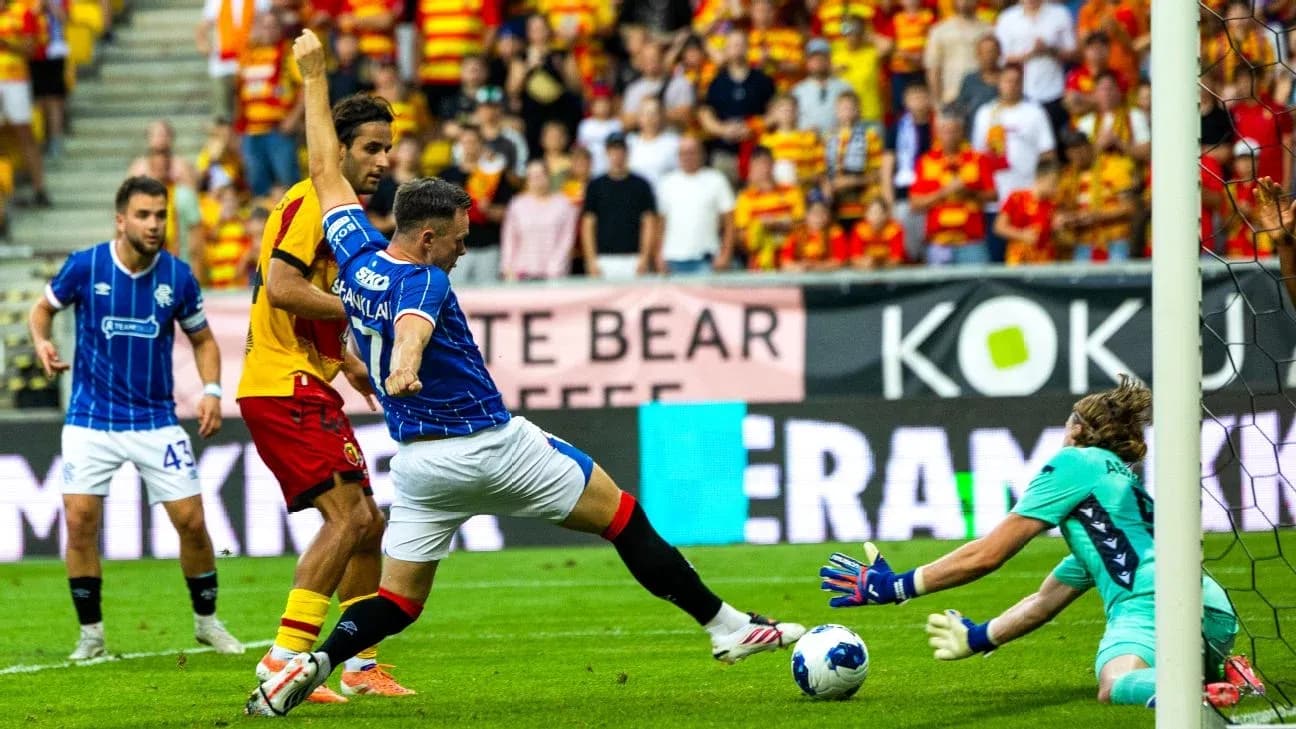
Jagiellonia’s 2-1 win over Rangers at Chorten Arena in the UEFA Europa League 3rd Qualifying Round was built on a clear structural contrast: a proactive 4-3-3 against a more layered 4-2-3-1 that never fully controlled the central lane. Despite only a narrow edge in possession (52% to 48%), the Polish side translated their shape into superior territorial pressure and higher-quality shooting positions, reflected in a 7–3 advantage in shots on goal.
Jagiellonia's Structure
Adrian Siemieniec’s 4-3-3 was configured to dominate the half-spaces. The back four of N. Wojtuszek, A. Konstantopoulos, Y. Kobayashi and G. Montoia played relatively compact, with R. Conceicao stepping out from the right half-space as an auxiliary full-back/holding midfielder. In front of them, T. Romanczuk anchored the midfield, allowing S. Lozano and K. Szmyt to operate as advanced eights. J. Imaz and Szmyt constantly drifted between the lines, with N. Prelec leading the line as a reference point.
This structure paid off early, even amid chaos. The own goal by G. Montoia after 4 minutes could have destabilised Jagiellonia, but instead their positional framework allowed them to respond quickly. By pushing both interiors higher and letting Romanczuk screen in front of the centre-backs, they compressed Rangers into their own third. The second Jagiellonia goal sequence — an own goal by E. Fernandez at 13 minutes followed by a composed finish from Szmyt at 21 minutes — reflected that pressure: Rangers’ back line was repeatedly forced into rushed defensive actions, with little midfield protection.
Defensive Strategy
Out of possession, Jagiellonia’s 4-3-3 flattened into a 4-1-4-1, with Imaz and Szmyt dropping alongside Lozano to form a second line of four. The pressing trigger was typically a sideways pass from Rangers’ centre-backs to the full-backs; Prelec would curve his runs to block the return pass, while the ball-near winger jumped aggressively. This approach limited Rangers to just 3 shots on goal and only 1 blocked shot all match, a sign that Jagiellonia were able to contest shooting lanes early rather than relying on last-ditch interventions.
Rangers' Struggles
Rangers, under Derek McInnes, set up in a 4-2-3-1 that struggled to connect its lines. The back four of D. Sterling, R. McCrorie, E. Fernandez and T. Rommens had two deeper midfielders, T. Chukwuani and D. Neil, ahead of them, with D. Yokota and T. Aasgaard wide, M. Diomande as a central creator and Chermiti up front. In theory, the double pivot should have given Rangers control in front of their defence; in practice, Jagiellonia’s advanced eights pinned them back.
The statistics underline this imbalance. Rangers managed 5 corner kicks to Jagiellonia’s 1, suggesting some territorial phases, but they were often reactive rather than orchestrated. Their 15 fouls to Jagiellonia’s 11 point to a side repeatedly arriving late into duels, particularly as they tried to stop transitions through the centre. The three yellow cards for Rangers, against just one for Jagiellonia, fit that pattern of defensive strain.
Second Half Adjustments
The triple substitution at 46 minutes — C. Devlin (IN) for T. Chukwuani (OUT), N. Raskin (IN) for D. Neil (OUT), and F. Curtis (IN) for D. Yokota (OUT) — was a clear attempt to regain central control and add more energy. Devlin and Raskin offered more mobility and aggression in the press, while Curtis provided fresh legs in the attacking line. Structurally, Rangers tried to turn the 4-2-3-1 into something closer to a 4-1-4-1 in possession, with one pivot stepping higher to match Jagiellonia’s midfield line. This did improve their ability to pin Jagiellonia deeper for spells, as evidenced by the corner count, but it did not translate into sustained high-quality chances, as the shots on goal tally remained modest.
In-Game Management
Jagiellonia’s in-game management was equally significant. At 65 minutes, J. Agbonifo (IN) came on for R. Conceicao (OUT) and A. Klynge (IN) for S. Lozano (OUT), signalling a shift towards more control and fresh legs in midfield rather than chasing additional goals. Later, at 80 minutes, D. Drachal (IN) replaced J. Imaz (OUT) and Y. Sylla (IN) replaced N. Prelec (OUT), further reinforcing the midfield block and adding a more counter-oriented threat up front. These changes helped Jagiellonia absorb Rangers’ late pressure without collapsing centrally.
Defensive Discipline
Defensively, Jagiellonia’s discipline in the final quarter-hour was notable. Yuki Kobayashi’s yellow card at 88 minutes was their only booking, compared with Rangers’ three cautions — Tuur Rommens at 5 minutes, Tochi Chukwuani at 34 minutes and Nicolas Raskin at 90+2 minutes. The timing of Rangers’ cards, particularly the early ones, reflected systemic issues: full-backs and pivots were being exposed by Jagiellonia’s interior runs and forced into interventions that broke rhythm but also accumulated risk.
Tactical Indicators
Without explicit data on saves, xG or passing accuracy, the clearest tactical indicators remain the shot profile and foul distribution. Jagiellonia’s 7 shots on goal from a slightly higher share of the ball and minimal corner count suggest they were efficient at turning structured possession into direct, central chances rather than relying on wide bombardment. Rangers’ 3 shots on goal, despite more corners and a similar possession share, point to a side that could reach the final third but lacked the central mechanisms — third-man runs, rotations around Diomande, or effective use of Chermiti as a wall player — to break Jagiellonia’s compact block.
Conclusion
In sum, this was a match where shape and spacing outweighed raw possession numbers. Jagiellonia’s 4-3-3, with aggressive eights and a disciplined single pivot, consistently disrupted Rangers’ 4-2-3-1 build-up and forced them into reactive defending. The statistical edge in shots on goal, the lower foul count and the more controlled disciplinary profile all align with what the scoreline already suggests: Jagiellonia imposed their tactical plan more coherently, and Rangers’ adjustments, though energetic, never fully redressed the structural imbalance.