.svg&w=384&q=75 "Naijagoal logo")

Germany's National Team Crisis: The DFB's Dilemma
Germany have been here before. That is the problem.
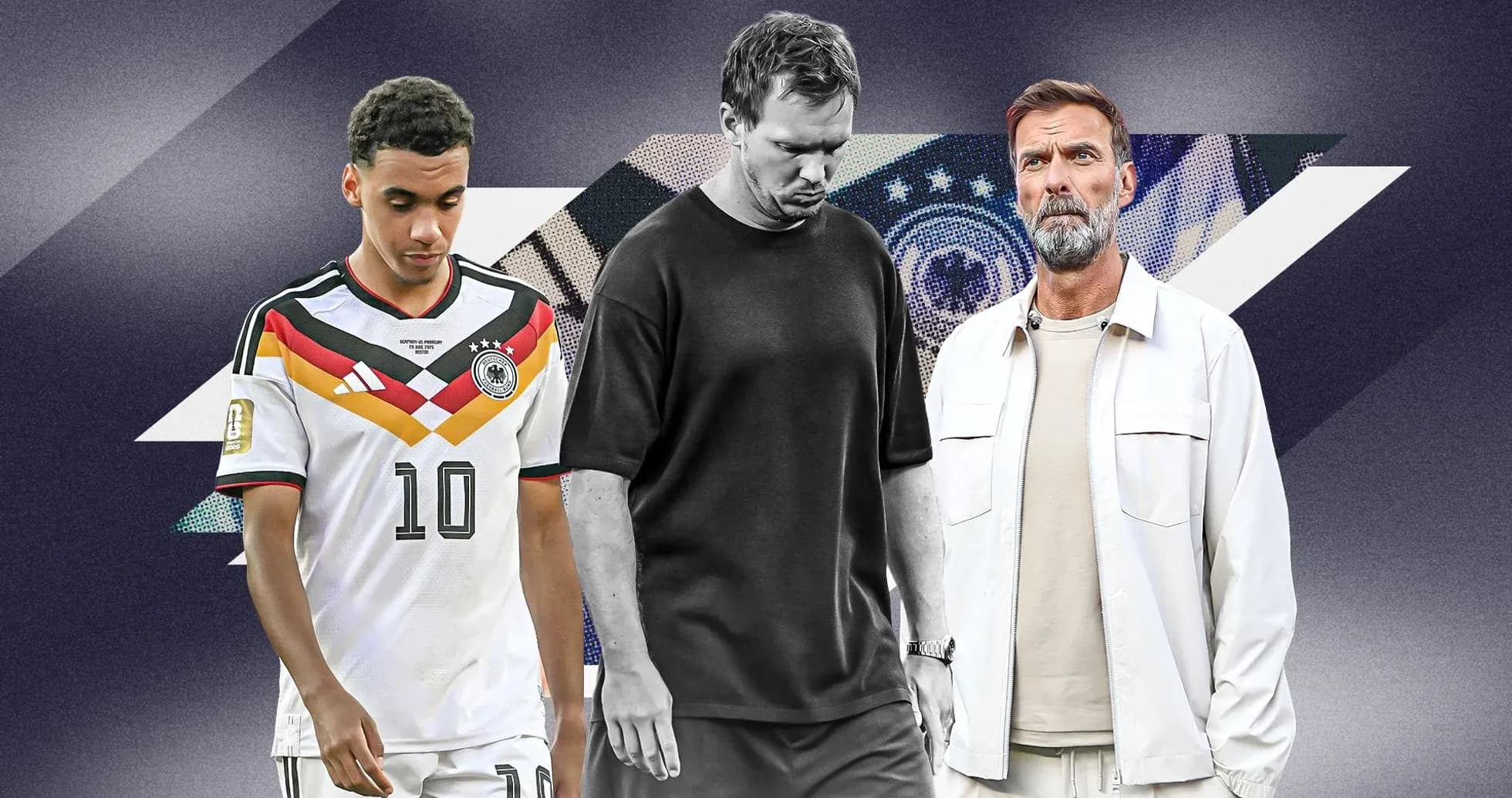
Ever since the 2018 World Cup collapse in Russia, the DFB has specialised in waiting too long, backing the wrong man for too long, hoping a broken project might somehow heal itself. Joachim Löw stayed when the evidence screamed for change. Hansi Flick survived one disaster too many. Now Julian Nagelsmann stands in the same spotlight, and Germany cannot afford to blink again.
From summit to spiral
When Löw’s Germany crashed out in the group stage in 2018, beaten by Mexico and South Korea, it felt like the natural end of an era. Twelve years in charge, a World Cup title, and then a humiliation. The logic pointed one way.
The DFB chose the other. Löw’s “credit in the bank” bought him three more years. Those years delivered drift, not renewal. Germany stumbled through to Euro 2020, showed no real evolution, and went out meekly to England in the last 16. Only then did Löw walk away.
Flick arrived as the bright new hope, carrying the glow of his Bayern Munich triumphs. He took Germany to Qatar on a wave of optimism. That lasted until the first meaningful test. Japan turned a 1–0 deficit into a 2–1 win, and the campaign never truly recovered. Another group-stage exit, another post-mortem, another opportunity for decisive action.
Again, the DFB hesitated. Flick stayed in post until the autumn of 2023, when a steady drip of bad results finally forced their hand. By the time Nagelsmann walked through the door, Germany had already lost years.
Nagelsmann’s rise – and rapid fall
Nagelsmann’s appointment in September 2023 felt like a reset. Young, sharp, tactically inventive, he immediately changed the mood. His squad choices looked bold and modern. The football at Euro 2024 on home soil did not restore Germany to their old supremacy, but it did something almost as valuable: it reconnected the team with the country.
Germany reached the quarter-finals, fell to eventual champions Spain, and walked away with their first genuinely respectable tournament showing in eight years. Players, coach and fans seemed finally aligned. Nagelsmann, riding that momentum, did not hide his ambition. The 2026 World Cup, he declared, would be his next target.
At that moment, he was the most popular national coach since peak Löw. Hard to reconcile that with the mood now.
In less than two years, Nagelsmann has burned through his goodwill at astonishing speed. The World Cup low point at Foxborough was not a freak result. It was the end product of a series of misjudgements – tactical, strategic and personal.
A coach who wouldn’t stop talking
One of the striking features of Nagelsmann’s tenure has been his use of the microphone. Press conferences and interviews became stages for detailed, sometimes brutal, public evaluations of his own players.
Every few weeks, another critique. Roles questioned, performances dissected, individuals named. It played as a coach hungry for attention, not a leader protecting his dressing room. Some of his statements were clumsy, others flatly contradicted previous promises he had made about certain players’ status in the squad.
When challenged, he rarely looked calm. At this World Cup in particular, his responses to critical questions often slipped into a patronising tone. The composure he demanded from his team deserted him in front of the cameras.
The words would have been easier to swallow had the football backed him up.
Neuer, Kimmich and the big calls that backfired
On the pitch, Nagelsmann’s biggest decisions carried a similar mix of conviction and contradiction.
Toni Kroos’ return for the Euros had been a clear success, a rare case of a backward glance paying off. That move helped persuade Nagelsmann to go further. He pulled Manuel Neuer, now 40, back into the fold for this World Cup, despite repeatedly insisting he would not.
The fallout was immediate. Oliver Baumann, rock-solid through qualifying, suddenly found himself shunted aside. It was handled poorly, felt unnecessary, and in the end proved exactly that. Neuer did nothing in this tournament that Baumann could not have done. No game-changing saves, no defining presence. Just the sense of a promise broken for no tangible gain.
Then came the Joshua Kimmich conundrum. Nagelsmann never settled on a position for his captain. Right-back one minute, central midfield the next, sometimes in the same match. The defeat to Paraguay underlined the chaos: Kimmich shuttled between roles while the team around him unravelled. A leader needs clarity; he got confusion.
A campaign without a heartbeat
Germany’s World Cup was a slow-motion failure. The warning signs had flashed since the Euros. The team had not moved forward, not in structure, not in identity. A brief second-half surge against minnows Curacao aside, this was a campaign without rhythm.
Against Ivory Coast, Ecuador and Paraguay – all respectable, none elite – Germany looked blunt in attack and fragile at the back. The front line lacked imagination, the defence creaked under pressure. There was no sustained control, no sense of a side building towards something.
In sporting terms, it cut deeper than 2022. At least in Qatar there had been a high-level draw against Spain to cling to. This time, nothing of that calibre. Just the feeling of a once-great team losing to average opposition and having no convincing explanation.
The players did what they could in the aftermath. They took collective responsibility, went out of their way to absolve Nagelsmann. It was admirable, but it did not change the reality. The coach’s primary duty is to provide a coherent plan. With the talent at his disposal, he never did.
His in-game management only reinforced that impression. Substitutions against Ecuador raised eyebrows, disrupting what little flow Germany had. The decision to start super-sub Undav against Paraguay, stripping him of the role in which he had been most effective, backfired badly.
The pressure finally told in Foxborough. And all the while, a familiar face sat in a TV studio, dissecting every misstep.
Klopp in the studio, Klopp in the air
Jurgen Klopp has long been the dream figure for German fans. At this tournament, he became something else: Nagelsmann’s shadow.
Working as a pundit for Magenta TV, Klopp broke down Germany’s failings with the clarity and directness that once electrified dressing rooms in Dortmund and Liverpool.
“You have to attack down the wings. There's no alternative,” he said after Germany’s elimination. “We all know how well these guys can play, but they didn't bring that to the pitch. In three months, we'll be raving about [Florian] Wirtz and [Jamal] Musiala again about how great they are, but not now.
“Paraguay had the opportunity to achieve something, Germany was under pressure to achieve something. Everyone in the stadium thought: Now they'll turn it around! But we didn't. We let them off the hook... We can talk about the DFB. We absolutely have to change a few things.”
It was not just what he said. It was who was saying it. The man many supporters now see as the obvious successor, outlining in real time the tactical adjustments Germany so clearly lacked.
For a growing section of the fanbase, the solution is simple: Klopp leaves his role as Red Bull’s head of soccer and leads Germany into Euro 2028 and the 2030 World Cup. The prospect alone would send a surge of euphoria through German football.
Klopp, of course, refused to take the bait when asked in Boston.
“I haven't thought about that yet. I understand that when the national coach position is discussed, my name is mentioned in some form. But it's not the moment to really talk about it. There's nothing to say about it. I have a job that I enjoy very much. As far as I know, it's not a part-time job.”
Typical Klopp: firm, but not definitive. Enough to cool the frenzy, not enough to kill the dream.
The decision the DFB can’t duck
Publicly, Nagelsmann still has support. The players have backed him. Sporting director Rudi Völler has done the same. On paper, the DFB could justify continuity.
Reality points the other way. The pattern is too familiar, the regression too stark. Germany have already paid the price for clinging to Löw and Flick long after their projects had run their course. To repeat that mistake with Nagelsmann would be negligence.
If the federation truly believes Klopp is the man to lead a new era, they cannot drag this out. Coaches with his profile and pull do not sit by the phone forever. The World Cup has exposed a national team stuck between eras, between ideas, between identities.
The next move will define the next decade. Does Germany double down on a failing experiment, or pick up the phone and see if the man in the studio is ready to step back into the dugout?