.svg&w=384&q=75 "Naijagoal logo")

Fulham vs Chelsea: Premier League Opener Analysis
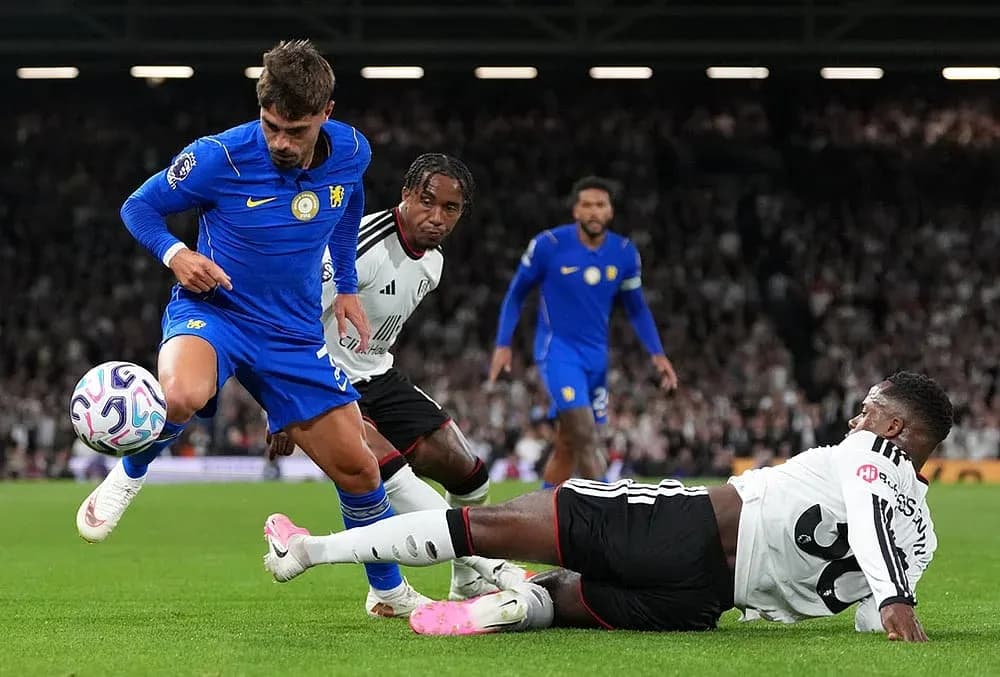
Craven Cottage under the lights, the Thames just beyond the old cottage roof, and a new Premier League season already asking sharp questions of both Fulham and Chelsea. The opener ends 3-2 to the visitors, and following this result the table tells a simple story: Fulham sit 12th with 0 points and a goal difference of -1 (2 scored, 3 conceded), Chelsea 6th with 3 points and a goal difference of 1 (3 scored, 2 conceded). But the numbers only hint at the tactical narratives that unfolded.
I. The Big Picture – Two Blueprints, One Fine Margin
Alvaro Arbeloa set Fulham up in a 4-2-3-1 that was as much about structure as it was about improvisation between the lines. Bernd Leno anchored a back four of Timothy Castagne, Calvin Bassey, Jorge Cuenca and Antonee Robinson. In front of them, Sander Berge and Alex Iwobi formed a double pivot, with Oscar Bobb, Josh King and Cristian Palacios knitting the attacking band behind lone forward Gorka Garcia.
Across the halfway line, Xabi Alonso’s Chelsea arrived with a clear identity: a 3-4-2-1 that wants to dominate the ball and the half-spaces. Robert Sanchez stood behind a back three of J. Acheampong, Maxence Lacroix and Levi Colwill. Malo Gusto and Reece James operated as aggressive wing-backs, with Roméo Lavia and Jorrel Hato inside. Ahead of them, Cole Palmer and Morgan Rogers floated behind Joao Pedro.
The league-wide stats, even after just one round, underline the contrast. At home, Fulham have played 1 match, scoring 2 goals and conceding 3, with home averages of 2.0 goals for and 3.0 against. On their travels, Chelsea have played 1, scoring 3 and conceding 2, with away averages of 3.0 goals for and 2.0 against. Both sides failed to keep a clean sheet; both look more dangerous going forward than secure at the back.
II. Tactical Voids – Absences and Discipline
This was not a full-strength Fulham rearguard. J. Andersen was suspended with a red card hanging over him, and Tom Cairney’s knee injury removed a calming, tempo-setting presence from midfield. In practice, that pushed more responsibility onto Berge as the deep organiser and forced Cuenca and Bassey into an untested partnership at Premier League tempo.
Chelsea’s absences were equally structural. Moises Caicedo’s injury deprived Alonso of his premier ball-winner and press-resistant hub at the base of midfield. Wesley Fofana’s suspension reduced depth and recovery pace in the back line, while the injuries to E. Emegha and M. Sarr, plus J. Henderson’s wrist issue, thinned both rotation and leadership options. It meant Lavia had to shoulder more defensive and build-up burden, and Lacroix became the de facto organiser at the back.
Discipline shaped the rhythm. Fulham’s season card profile is brutally clear: 100.00% of their yellow cards have arrived between 76-90 minutes, a late-game surge that reflects both fatigue and the desperation of chasing the match. Castagne already sits on one yellow, and his role as an overlapping full-back makes him a repeat candidate for late tactical fouls.
Chelsea, by contrast, front-loaded their aggression. Two of their yellows this season have come in the 0-15 minute window (66.67% of their total), with another between 61-75 minutes (33.33%). Lavia’s booking encapsulates the risk in Alonso’s plan: an early, high-intensity press that can tilt matches in their favour but leaves key midfielders walking a disciplinary tightrope.
III. Key Matchups – Hunter vs Shield, Engine Room Battles
The “Hunter vs Shield” narrative for Chelsea is already defined by Cole Palmer. In total this campaign, he has 1 goal and 1 assist from 1 appearance, with 4 shots (2 on target), 32 passes at 87% accuracy, and 8 dribbles attempted with 5 successful. He is not just a finisher but the creative hub, drawing 3 fouls and winning 10 of 16 duels. Joao Pedro mirrors that dual threat with 1 goal, 1 assist, 3 shots and 2 key passes, while Rogers adds another 1 goal and 5 key passes from the left channel.
Against Fulham’s defensive structure, that trio repeatedly targeted the spaces around Berge and Iwobi and the channels outside Cuenca and Bassey. Without Andersen’s aerial dominance and leadership, Fulham’s back line had to defend more space and more variety of movement. Castagne’s own numbers this season – 1 shot on target, 40 passes at 85% accuracy, 2 key passes, plus 1 tackle, 1 interception and 1 successful block – show his dual role as both outlet and emergency defender. But when he steps high to support Bobb, the channel behind him becomes a runway for Palmer and Gusto.
In the engine room, Lavia’s profile is instructive. Across his 65 minutes, he completed 22 passes at 95% accuracy, with 2 key passes, 3 tackles and 1 interception. He also took 1 shot on target and committed 1 foul, collecting that yellow card. His ability to win second balls and immediately find Palmer or Rogers is the hinge of Chelsea’s transition game. Against Fulham’s double pivot, his calmness under pressure allowed Chelsea to play through the first line and pin the hosts back.
On the other side, Berge’s role is less glamorous but just as pivotal. With Fulham failing to keep a clean sheet and conceding 3.0 goals per home game so far, his screening of the back four will determine whether the side can stabilise. Iwobi, meanwhile, must connect defence to attack more consistently if Fulham are to turn their 2.0 home goals per game into points rather than consolation.
IV. Statistical Prognosis – Patterns Beneath the Scoreline
Following this result, the numbers sketch a clear early-season identity. Fulham at home are open, enterprising and exposed: 2 goals scored, 3 conceded, no clean sheets, and no penalties taken or missed. Their late yellow-card spike between 76-90 minutes suggests matches that become increasingly stretched and frantic as they chase equalisers.
Chelsea away are high-ceiling but not watertight: 3 goals scored, 2 conceded, no clean sheets, and again no penalties involved. Their card pattern – early aggression, then another booking around the hour – reflects a side that wants to seize control quickly, then reassert it when the opponent rallies.
Even without explicit xG values, the shot and chance-creation data around Palmer, Joao Pedro and Rogers indicate a Chelsea attack that regularly manufactures high-quality opportunities. Palmer’s 3 key passes, Joao Pedro’s 2, and Rogers’ 5 in a single outing point to a multi-source creative threat rather than a one-man show. Combine that with Lacroix’s 50 passes at 94% accuracy, 5 tackles, 1 block and 2 interceptions, and you have a spine capable of both building from deep and snuffing out counters.
For Fulham, the prognosis is more fragile but not bleak. Their 2 goals at home show they can hurt opponents, and the 4-2-3-1 clearly gives licence to Bobb, King and Palacios to find pockets and feed Garcia. Yet until the defensive structure tightens – especially in the channels and in late-game phases where discipline currently frays – they will live on the edge.
Chelsea leave Craven Cottage with the points and, more importantly, a template: a 3-4-2-1 built around Palmer’s gravity, Joao Pedro’s movement and a back three led by Lacroix that can survive high-risk pressing. Fulham leave with questions about balance and resilience, but also with enough attacking promise to believe that once the back line settles and key absentees return, nights like this might tilt their way instead of ending in a narrow, breathless defeat.