.svg&w=384&q=75 "Naijagoal logo")
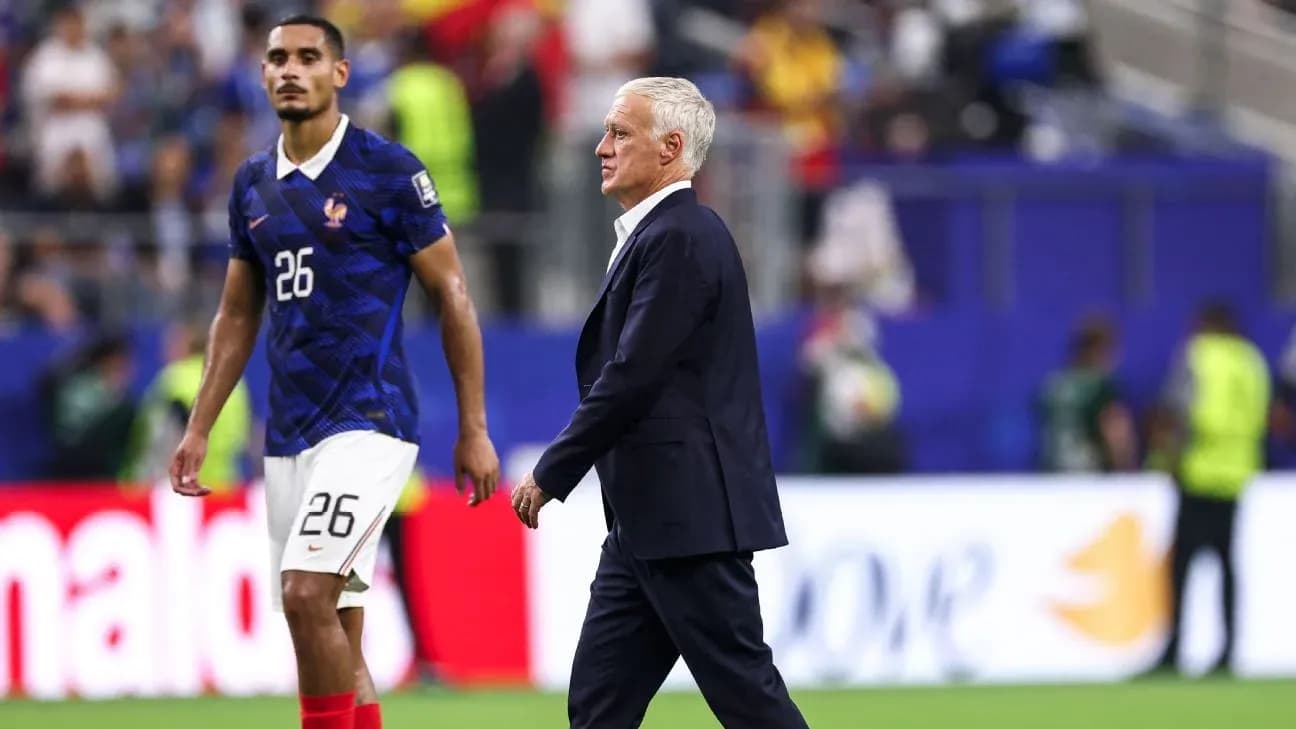

France's World Cup Exit: Deschamps' Era Ends with a Whimper
ARLINGTON, Texas — The end came quietly for France, which is perhaps the most damning thing you can say about a team this gifted.
No late surge. No furious comeback. No sense that a heavyweight had gone down swinging.
They arrived at this World Cup as favorites and carried that label with a certain inevitability all the way to Tuesday afternoon in Jerry Jones’ vast Texas monument, where Spain finally pushed them behind for the first time in the tournament. France never found a way back. A 2-0 defeat felt, by the final whistle, almost generous.
It was the end of a match. It was also the end of an era.
Didier Deschamps walks away after 14 years, 184 games, three major finals and a Nations League title. He leaves as one of international football’s most successful managers and yet, after this semifinal, with a fanbase that largely seems ready to turn the page and fast-forward to the Zinedine Zidane chapter.
Football can be brutal like that. He was one Randal Kolo Muani finish away in 2022 from becoming only the second coach to win two World Cups, adding to the one he lifted as a player. Now he exits on the back of a performance so lifeless that his front four produced 0.04 xG in the first 64 minutes. For a side stacked with attacking royalty, that number reads like an indictment.
Spain didn’t just beat France. They unstitched them.
De la Fuente’s hold over Deschamps
This wasn’t a one-off. Luis de la Fuente has turned Deschamps into a recurring victim.
First came the Euro 2024 semifinal. Then the wild Nations League clash in 2025, when Spain were 5-1 up before a late French rally made it 5-4. Now this World Cup semifinal, the most comprehensive of the three. Either de la Fuente is Deschamps’ bespectacled, bald, bearded kryptonite, or the French coach simply never found the learning curve.
Each time they met, Spain grew more coherent. France, somehow, grew worse.
Everyone knew the broad outlines of how this game would look. Spain would dominate the ball, circulate it patiently, probe for gaps. The real question sat on Deschamps’ desk: adapt or impose?
Would he add a midfielder to try to level the numbers in the center of the pitch — Kylian Mbappé himself had flagged the “two vs. three” issue — or press more aggressively, or find some way to disrupt Spain’s rhythm? Or would he trust that his superior talent would bend the game to his will?
He chose the latter. Spain gratefully accepted the invitation.
When you have the better players, the conventional wisdom says you force others to react to you, not the other way around. Deschamps has built a career on that logic. This time, it turned on him.
The limits of simplicity
Deschamps’ managerial philosophy has never been a secret. Keep the dressing room happy, keep the system clear, don’t drown players in detail, and let elite talent tilt the margins in a low-scoring sport. It worked when he shared a pitch with Zidane, Patrick Vieira and Thierry Henry in 1998. It worked again from the touchline in 2018 and very nearly in 2022.
There is a reason his résumé commands respect.
But football changes when you are denied the two basic tools of expression: the ball and space. Spain took both away. They hogged possession and squeezed up the pitch, closing the lanes in behind. Without room to run or time to think, even France’s brightest stars looked ordinary. Michael Olise, stripped of those conditions, suddenly offered little more than Michael Scott.
That is the moment when great managers earn their reputation. They adjust. They break their own patterns. They change the picture for their players.
Deschamps never really has. Not consistently. Not against opponents at this level.
His substitutions here felt like muscle memory rather than inspiration: Manu Koné, the more progressive passer, for Adrien Rabiot; Désiré Doué for Bradley Barcola. Logical moves on paper, entirely predictable in practice. The footballing equivalent of hitting the suggested reply on your phone.
On a good night, that kind of conservatism reassures a team and preserves structure. On this night, it simply elongated the suffering.
The same goes for his loyalty to certain players. Rabiot, above all, but also Olise, who endured a nightmare. Trust can be a superpower for a coach; it can also become a blind spot. The traits that powered Deschamps to unprecedented longevity with France ultimately dragged him down just as he finally assembled his most dazzling squad.
Enter Zidane, with questions attached
Now the stage tilts toward Zidane.
On paper, his credentials glisten: three Champions League titles, two LaLiga crowns. He managed egos and pressure at Real Madrid, football’s most unforgiving fishbowl, and came out with a trophy haul that would make most coaches blink.
But that glitter comes with caveats. Zidane has not worked in five years. His last trophy dates back to 2020. His entire coaching life has unfolded at one club, a place unlike any other. At Madrid, when a player didn’t fit, there was always another superstar around the corner. At international level, you live with what your country produces. You don’t dip into a transfer market to solve your problems.
Zidane also built his reputation at the Bernabéu without leaning on complex tactical schemes. He trusted stars, managed moods, and found the right buttons to push. He was, in many ways, a kindred spirit to Deschamps, his former teammate for France and Juventus.
That invites an easy assumption: that France are swapping one minimalist for another.
It doesn’t have to be that way. The lesson from Arlington is not that Deschamps’ approach was inherently flawed, but that he rarely shifted from it when circumstances demanded. Zidane, if he is indeed next, has the chance to move faster along that curve — to recognize those nights when simply sending out your best XI and telling them to “do their thing” is not enough.
Balance matters. So does the reality that the other team isn’t just there to admire your talent; they’re there to strangle it. Zidane should understand this better than most. He won a World Cup with Stéphane Guivarc’h as his center forward, after all. Deschamps did too. They know what it looks like when a collective structure elevates individuals who, on paper, shouldn’t belong at that level.
That is the core message from this defeat. When the technical gap is small, the team with the stronger collective often beats the side with the shinier names.
Zidane will inherit a player pool that most international coaches can only dream of, especially in attack. He has had years to study this generation from afar, to ponder how he would shape it. The bar is high: match Deschamps’ haul of finals and trophies, and he will be judged a success.
The question is whether he can take this France side somewhere Deschamps, for all his medals, never quite managed to reach — a place where talent and structure finally pull in the same ruthless direction.