.svg&w=384&q=75 "Naijagoal logo")

France Dominates Sweden 3-0 in World Cup Showdown
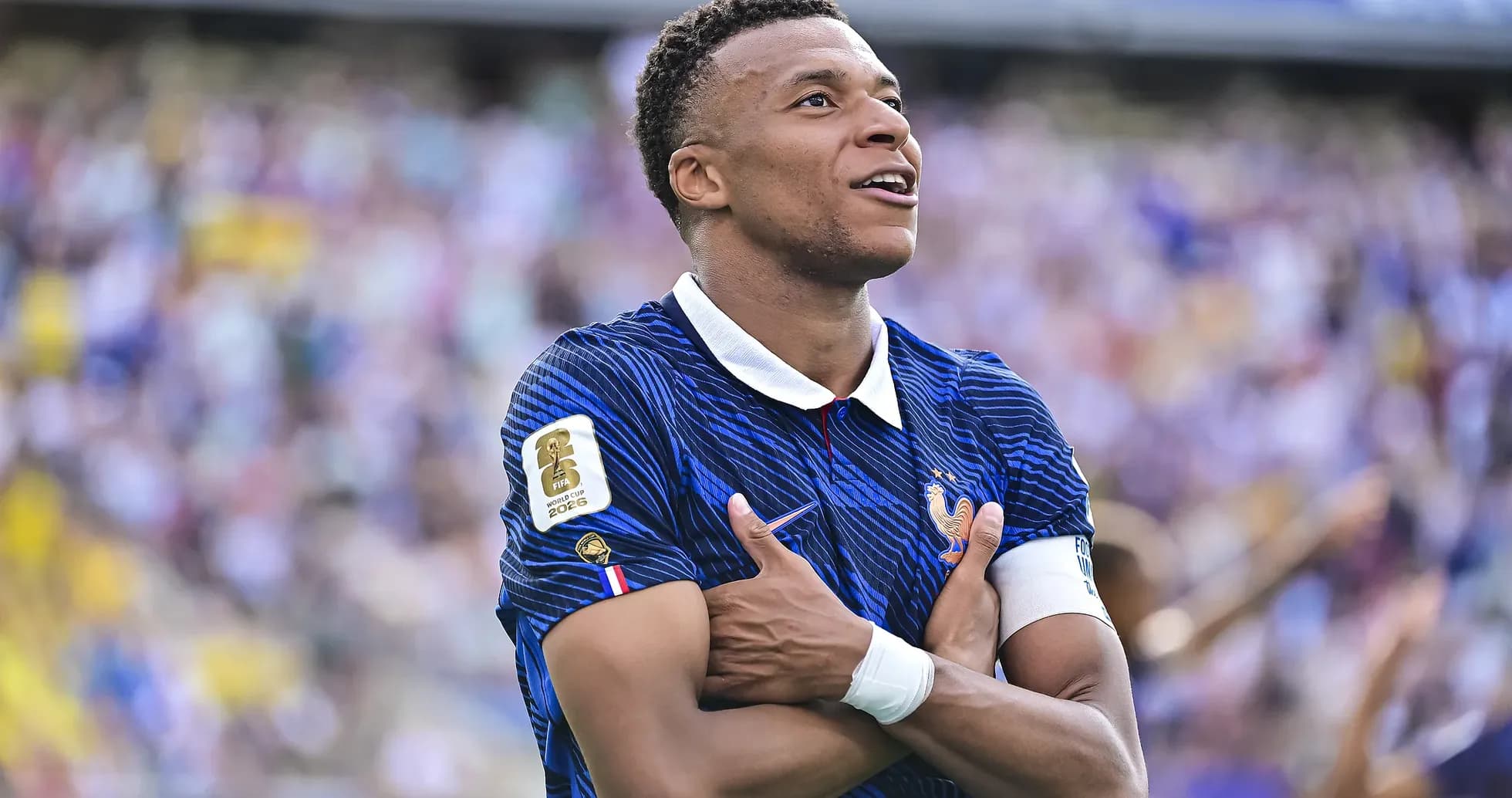
France’s 3-0 win over Sweden at MetLife Stadium in this World Cup Round of 32 tie was a controlled, structurally coherent performance built on a dominant 4-2-3-1 and a clear plan to stretch Sweden’s 4-4-2 block. The scoreline matched the underlying data: France generated 25 shots to Sweden’s 8, with a 3.17 xG to 0.65 gap, and enjoyed 61% of the ball. Within that framework, key attacking roles for Kylian Mbappé, Bradley Barcola and Michael Olise, plus an assertive double pivot, systematically dismantled Graham Potter’s compact but reactive side.
I. EXECUTIVE SUMMARY
France, set up by Didier Deschamps in a 4-2-3-1, imposed territorial and technical control from the outset. Their structure allowed them to pin Sweden deep, repeatedly accessing the half-spaces and wide channels to create high-quality chances. Mbappé’s brace and Barcola’s strike reflected not just individual quality but a repeatable pattern of overloads around Sweden’s full-backs and the inside channels. Sweden’s 4-4-2, with Viktor Gyökeres and Alexander Isak up front, struggled to connect in transition and rarely broke France’s rest-defence, finishing with only 3 shots on target and a single corner.
II. SCORING SEQUENCE & DISCIPLINARY LOG
There were no cards shown in this match, so the tactical story is told entirely through goals and substitutions.
The breakthrough came at 45', a psychologically decisive moment. With France circulating the ball patiently, they managed to disorganise Sweden’s right side. Ousmane Dembélé, operating from the right in the line of three behind Mbappé, provided the assist: his delivery found Mbappé, who finished to give France a 1-0 lead right on the cusp of half-time. The timing mattered tactically, rewarding France’s insistence on wide overloads and pinning Sweden even deeper for the second half.
At 53', the second goal crystallised France’s dominance between the lines. Michael Olise, playing as a central or right-sided creator in the 4-2-3-1, assisted Bradley Barcola. The pattern again involved France exploiting the spaces around Sweden’s midfield four; once the first line was bypassed, Barcola could attack the defensive line with support and angle his run to finish, pushing the score to 2-0 and forcing Sweden to chase the game.
The third goal at 74' came from the same structural superiority. Olise again provided the assist, this time for Mbappé, who completed his brace. By then, Sweden’s block was more stretched, with lines separated as they tried to press higher and find a route back. France’s ability to play through or around that pressure, using Olise’s positioning and Mbappé’s movement across the front line, turned control into a decisive 3-0.
Substitutions followed the flow of the contest. At 66', Sweden tried to inject new energy and creativity: Besfort Zeneli (IN) came on for Elliot Stroud (OUT), and Taha Abdi Ali (IN) came on for Lucas Bergvall (OUT), signalling a shift towards more attacking profiles in midfield and wide areas. France responded from a position of strength at 75', refreshing key wide and full-back roles: Malo Gusto (IN) came on for Jules Koundé (OUT), and Désiré Doué (IN) came on for Ousmane Dembélé (OUT), maintaining intensity on the flanks.
At 78', Theo Hernández (IN) came on for Lucas Digne (OUT), adding a more aggressive overlapping threat even with a two-goal cushion. Sweden’s double change at 82' — Benjamin Nygren (IN) for Yasin Ayari (OUT) and Mattias Svanberg (IN) for Daniel Svensson (OUT) — further underlined their need to chase, but without changing the fundamental dynamic. Finally, at 85', Jean-Philippe Mateta (IN) came on for Michael Olise (OUT) and Rayan Cherki (IN) for Kylian Mbappé (OUT), preserving legs and adding fresh attacking options with the tie effectively decided. Sweden’s last move at 89' saw Gustaf Nilsson (IN) replace Alexander Isak (OUT), a late attempt to alter the profile of the front line.
III. TACTICAL BREAKDOWN & PERSONNEL
France’s 4-2-3-1 was the platform for dominance. Aurélien Tchouaméni and Adrien Rabiot formed a double pivot that balanced progression and protection. With 551 total passes and 485 accurate (88%), France used short and medium passing to fix Sweden’s first line of pressure and then break lines into the feet of Olise, Dembélé and Barcola. The full-backs, Jules Koundé and Lucas Digne, provided width, allowing the wide midfielders to occupy half-spaces and drag Sweden’s wide midfielders and full-backs into uncomfortable decisions.
The shot profile (25 total shots, 16 inside the box) illustrates how effectively France got into advanced zones. Only 4 attempts were blocked, underlining how often they managed to create clean looks rather than speculative efforts. Nine corner kicks reflected sustained territorial pressure and second-phase dominance around the Swedish box.
Out of possession, France were compact and aggressive in their counter-press. Sweden’s 4-4-2, with Anthony Elanga and Elliot Stroud wide and Lucas Bergvall and Yasin Ayari central, found it difficult to link with Gyökeres and Isak. Sweden managed 8 total shots, 7 from inside the box, but only 3 on target and just 1 corner, showing that when they did reach the final third, it was sporadic and under pressure rather than through controlled progression.
In goal, Mike Maignan (France) was rarely threatened but still had to make 3 saves, aligning with Sweden’s 3 shots on target. His involvement was mostly about sweeping and distribution, helping France reset possession rather than emergency shot-stopping. Jacob Widell Zetterström (Sweden), by contrast, was under siege: he made 9 saves, a number that, combined with France’s 12 shots on goal, highlights how much work he had to do just to keep the scoreline at 3-0. The goals prevented metric reinforces both goalkeepers’ impact: France’s 3.17 xG versus 3 actual goals, and Sweden’s 0.65 xG with no conversion, paired with both sides’ goals prevented figure of 1.16, suggests that Maignan (France) and Widell Zetterström (Sweden) each produced interventions that exceeded baseline expectations, even if the French keeper’s work was less frequent.
Sweden’s 352 passes (280 accurate, 80%) and 39% possession underline a reactive game plan. Their 4-4-2 aimed to remain compact horizontally, but France’s rotations in the line of three behind Mbappé repeatedly pulled their midfield out of shape. When Sweden tried to transition, France’s rest-defence — with Dayot Upamecano and William Saliba holding an aggressive line and Tchouaméni screening — generally snuffed out counters before they could become clear chances.
IV. THE STATISTICAL VERDICT
The numbers strongly support the tactical impression. France’s 61% possession, 25 shots (12 on target) and 3.17 xG point to sustained, high-quality attacking pressure. Sweden’s 8 shots, 3 on target and 0.65 xG show that while they did reach the box on occasion, they rarely created clear, repeatable chances.
Discipline was clean: despite 14 fouls by France and 10 by Sweden, there were no yellow or red cards. This allowed the game to flow, which clearly favoured France’s superior technical and positional structure. The pass volumes and accuracy — France’s 551 passes at 88% versus Sweden’s 352 at 80% — reflect not only control but also France’s ability to circulate the ball under pressure and re-attack after regains.
Defensively, the goals prevented figure of 1.16 for both sides, combined with Maignan’s 3 saves and Widell Zetterström’s 9, suggests that each goalkeeper outperformed baseline expectations, though the French structure limited Sweden’s volume of attempts. In aggregate, the 3-0 scoreline, the xG gap, and the territorial dominance all align: this was a tactically mature, statistically backed display by France, and Sweden’s adjustments from the bench were not enough to disrupt the French control of space, tempo and chance quality.