.svg&w=384&q=75 "Naijagoal logo")

FIFA Revises Water Bottle Policy for 2026 World Cup
FIFA has moved to defuse a growing storm over fan safety and comfort at the 2026 World Cup, softening its stance on water bottles after a sharp public backlash.
Two days after confirming that refillable bottles would be banned from stadiums, world football’s governing body announced that supporters will now be allowed to bring in one disposable bottle of water to matches in the United States and Canada.
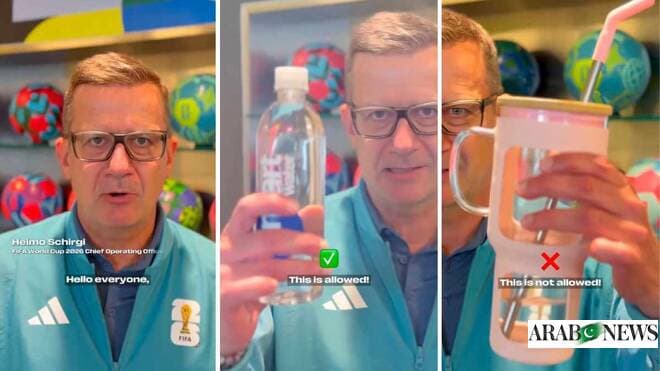
In a video posted on FIFA’s X account, World Cup chief operating officer Heimo Schirgi set out the revised position in clear terms.
“All fans will be permitted to bring in one, soft, plastic 20 ounces (590ml), factory sealed disposable water bottle into any FIFA World Cup 2026 match in the USA and Canada,” he said.
The governing body described the move as a “clarification” of its policy, but the shift comes only after widespread criticism that the original rule would leave fans at the mercy of stadium prices in potentially dangerous heat.
Safety vs. comfort
The core of FIFA’s argument has not changed. Safety, it insists, still comes first.
Schirgi underlined that “fans will not be permitted to bring in hard sided, reusable water bottles due to safety and security reasons,” holding up examples of what will and will not be allowed through the turnstiles.
FIFA has long argued that outside bottles can be used as projectiles or weapons and pointed out that several of the World Cup venues already prohibit them for domestic events. The organization says it is simply applying those same standards across all tournament stadiums.
Those safety concerns, FIFA stressed again on Friday, “remain valid.”
Yet the context around this World Cup is different. And fans know it.
Heat fears around 2026
The 2026 tournament, spread across the United States, Canada and Mexico, will lean heavily on open-air venues in the North American summer. Forecasters have warned that the conditions could be punishing.
A report last month from the World Weather Attribution research group estimated that 26 of the 104 World Cup matches are likely to be played in conditions where the Wet Bulb Global Temperature (WBGT) exceeds 26 degrees.
WBGT is not just another temperature reading. It blends heat, humidity, wind and sunlight into a single measure of how much stress the human body is under. Once it climbs, the risk of heat-related illness rises sharply, especially in crowded, sun-exposed stands.
Supporters in the United States have already had a taste of what that can feel like. At last year’s FIFA Club World Cup, fans complained of searing temperatures and were still barred from bringing water bottles into venues.
The memory of those scenes helped fuel the anger when FIFA’s initial 2026 policy appeared to shut the door on any outside water at all.
Inside the stadium footprint
FIFA insists fans will not be left to wilt.
The organization has pointed to a range of measures it says will be in place “in the stadium footprint”: misting stations, fans, hydration stations and cooling tents. These are designed to give supporters somewhere to cool off, rehydrate and recover during the day-long experience that surrounds a World Cup match.
Once inside, bottled water will be on sale, with FIFA saying prices will “remain consistent with other events held at each stadium.” That line, though, offers little comfort to those who have paid premium prices for drinks at major US sports events and concerts in recent years.
The compromise now on the table is narrow but significant: one soft, factory-sealed disposable bottle per fan, no refills from home, no metal flasks or heavy reusable containers.
The debate that forced this climbdown will not disappear. With the world’s biggest tournament heading into some of its hottest markets, every detail of how fans are protected, hydrated and treated will be under the spotlight long before the first ball is kicked.