.svg&w=384&q=75 "Naijagoal logo")

Ferencvarosi TC vs Twente: Tactical Analysis of a 2-2 Draw
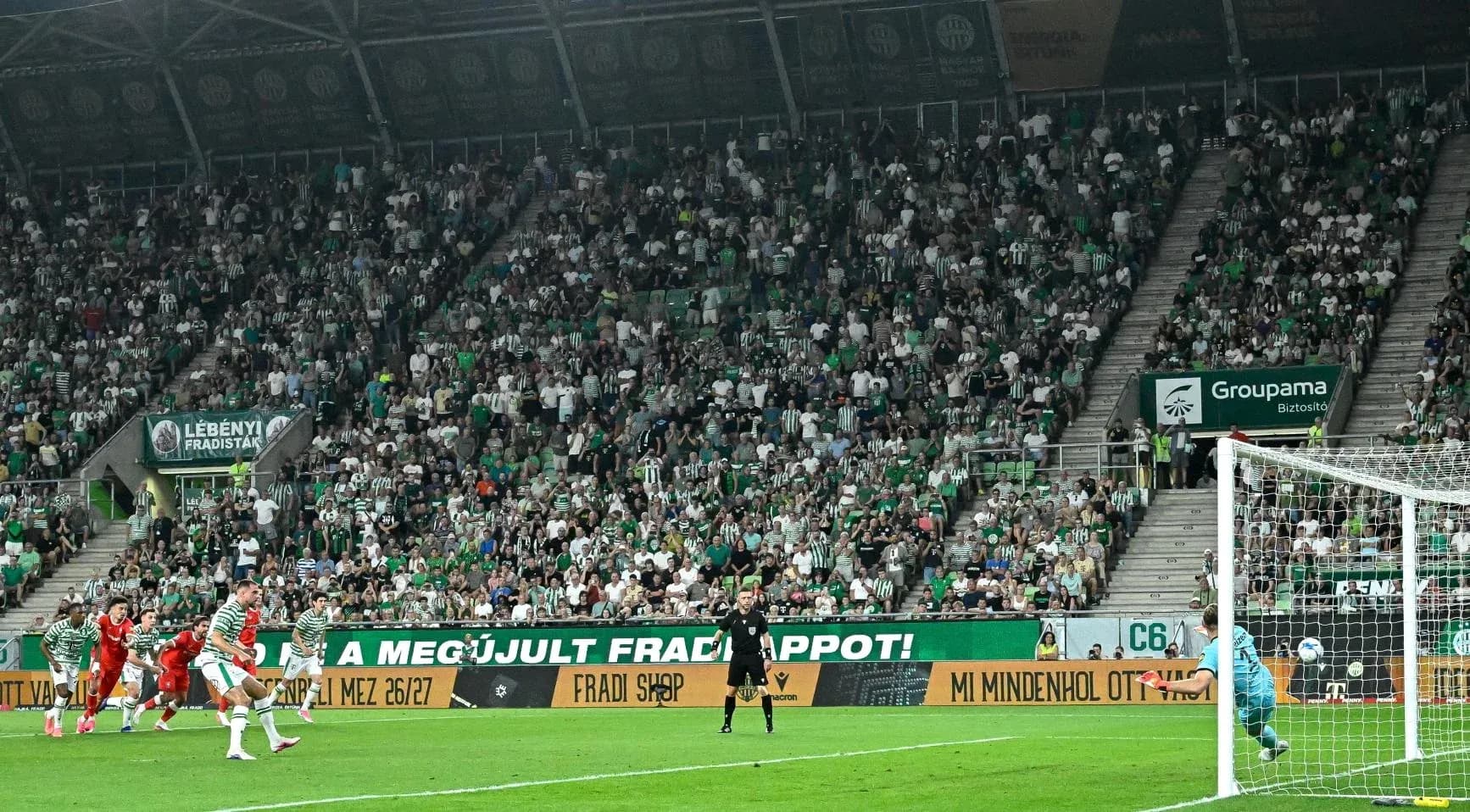
Ferencvarosi TC and Twente produced a tactically volatile 2-2 draw at Groupama Aréna in the UEFA Europa League 2nd Qualifying Round, a match defined more by structural adaptation and game-state management than by statistical dominance, given the absence of detailed shot and possession data. Ferencvaros led 1-0 at half-time and stretched it to 2-0 despite going down to ten men before the interval, only for Twente’s bench and wing dynamics to overturn the momentum and claw back a draw in the final ten minutes. Both sides lined up in a 4-3-3, but their shapes evolved radically after the 36th-minute red card and a wave of second-half substitutions.
The scoring timeline underpins the tactical story. On 22', T. Raemaekers (Ferencvarosi TC) converted a penalty — no assist — to make it 1-0. At 36', P. Rommens (Ferencvarosi TC) received a Red Card — Serious foul, forcing the hosts into a reactive, compact block. Early in the second half, on 50', L. Joseph (Ferencvarosi TC) struck a Normal Goal — no assist — to extend the lead to 2-0, briefly validating Ferencvaros’s transitional approach with ten men. Twente’s response arrived late but decisively: on 82', W. Weghorst (Twente) scored a Normal Goal — no assist — for 2-1, and on 86', L. Vennegoor of Hesselink (Twente) added another Normal Goal — no assist — to level the match at 2-2, the final score.
Disciplinary Events
Disciplinary events were numerous and shaped the rhythm. Chronologically:
- 36' P. Rommens (Ferencvarosi TC) — Serious foul (Red Card)
- 56' Cadu (Ferencvarosi TC) — Unsportsmanlike conduct (Yellow Card)
- 56' T. van den Belt (Twente) — Unsportsmanlike conduct (Yellow Card)
- 61' S. Lemkin (Twente) — Unsportsmanlike conduct (Yellow Card)
- 88' Y. Taha (Twente) — Foul (Yellow Card)
Totals: Ferencvarosi TC: 1 yellow, 1 red; Twente: 3 yellows; Total: 5 cards.
Both teams started in a 4-3-3, but the roles inside those systems diverged. For Ferencvarosi TC, D. Dibusz anchored the side from goal, with a back line built from M. Gomez and T. Raemaekers centrally, flanked by Cadu and A. Osvath. The midfield trio of P. Rommens, G. Kanichowsky and M. Corbu was designed for balance: Rommens as the deeper distributor and first presser, Kanichowsky as a shuttle, and Corbu supporting the left side. Ahead of them, K. Zachariassen and C. O'Dowda worked as narrow wide midfielders around the central presence of L. Joseph, giving the nominal 4-3-3 a strong interior focus.
Twente’s 4-3-3 under John van den Brom was more classically structured. L. Unnerstall was protected by a back four of B. van Rooij, S. Lemkin, R. Nijstad and A. Adelgaard. In midfield, R. Zerrouki held the base, with K. Hlynsson and T. van den Belt as dual No. 8s tasked with progressing play between the lines. The front three — D. Rots and S. Orjasaeter either side of W. Weghorst — offered width and aerial threat, with Weghorst as the clear focal point for crosses and direct entries.
The 22' penalty converted by Raemaekers reflected Ferencvaros’s early ability to attack through central overloads, drawing Twente’s defenders into awkward positions. With Rommens orchestrating from deep, the hosts could step their full-backs high, especially Cadu, while Zachariassen and O'Dowda tucked inside to combine. The 1-0 lead allowed Ferencvaros to compress the pitch and press more aggressively in midfield.
The match’s tactical hinge came at 36' with the red card to Rommens for Serious foul. Ferencvaros lost their primary pivot and were forced into emergency rebalancing: the midfield triangle effectively flattened, with Kanichowsky and Corbu having to cover larger horizontal distances and one of the advanced midfielders dropping closer to the back four out of possession. From that moment, the home side’s 4-3-3 morphed into something closer to a 4-4-1 without the ball, with Joseph left to run channels and hold up play.
Remarkably, Ferencvaros struck next. On 50', Joseph’s Normal Goal for 2-0 embodied their ten-man strategy: quick vertical release to the lone forward, exploiting space as Twente pushed higher. That goal temporarily validated Balazs Borbely’s decision to keep a forward reference rather than fully retreat into a low block.
Substitutions then reoriented the game. At 46', Twente adjusted immediately after the break: S. Lammers (IN) came on for K. Hlynsson (OUT), and D. Weidmann (IN) came on for A. Adelgaard (OUT). Lammers added a second central reference around Weghorst, allowing Twente to threaten with dual strikers in many phases while Orjasaeter and Rots could hold width. Weidmann’s introduction rebalanced the left side, supporting overlapping runs and second-phase pressure.
On 56', a double booking — Cadu and T. van den Belt both for Unsportsmanlike conduct — underlined the rising intensity around second balls and duels in midfield. Twente then refined their structure further: at 63', Y. Taha (IN) came on for T. van den Belt (OUT), providing more vertical running and aggression between the lines. At 72', they executed a decisive attacking reshuffle: M. Pjaca (IN) came on for D. Rots (OUT), and L. Vennegoor of Hesselink (IN) came on for S. Orjasaeter (OUT). This pushed Twente into a more overtly attacking shape, with multiple forwards rotating around Weghorst and Pjaca providing creative width and 1v1 threat.
Ferencvaros, meanwhile, sought to preserve energy and hold their shape. At 73', Dele (IN) came on for C. O'Dowda (OUT), adding fresh legs in the wide/half-space role. At 78', N. Zohore (IN) came on for L. Joseph (OUT), swapping like-for-like in the central attacking slot but with more emphasis on physical duels and defensive pressing from the front. Late on, at 88', J. Levi (IN) came on for Cadu (OUT), a move that likely aimed to stabilize the right flank and introduce a more conservative profile after Cadu’s earlier booking.
The final phase reflected Twente’s structural superiority against a tiring ten-man block. Weghorst’s 82' goal for 2-1 came as Twente maximized crossing situations and central overloads, using their multiple forwards to pin Ferencvaros’s centre-backs and attack second balls. The 86' equaliser from L. Vennegoor of Hesselink for 2-2 rewarded van den Brom’s aggressive substitution pattern: with Lammers, Weghorst and Vennegoor of Hesselink all involved in advanced zones, Ferencvaros’s depleted midfield could no longer protect the back four adequately.
Discipline further tilted momentum. Twente accumulated three yellows — van den Belt, Lemkin, Taha — but crucially kept eleven players on the pitch, allowing them to sustain pressure and maintain a high line without catastrophic risk. Ferencvaros’s single yellow to Cadu, combined with Rommens’s red, forced their wide defenders to be more cautious in duels, inviting Twente to advance their full-backs and midfielders higher in the second half.
From a statistical verdict standpoint, the lack of concrete data on shots, possession, passes, xG and goalkeeper saves prevents precise quantification of dominance or efficiency. However, the game-state narrative is clear: Ferencvarosi TC were structurally sound and opportunistic 11v11, then impressively clinical in transition at 10v11 to reach 2-0. Twente’s comeback was driven less by raw numbers and more by intelligent use of the bench, layered attacking structure and numerical superiority in midfield. The card profile — Ferencvaros with 1 yellow and 1 red, Twente with 3 yellows — underscores a match in which the home side’s single dismissal outweighed any marginal disciplinary advantage Twente might have conceded through cautions. Over two halves, this 2-2 draw reads as Ferencvaros’s tactical resilience meeting Twente’s depth and late-game attacking recalibration.