.svg&w=384&q=75 "Naijagoal logo")

England vs Norway: World Cup Quarterfinal Showdown
Miami will sweat. England and Norway will suffer.
On Saturday night in Florida, two very different World Cup stories collide: a resurgent heavyweight trying to avoid another quarterfinal exit, and a fearless outsider riding the kind of wave that usually belongs in mythology, not tournament brackets.
Norway, back at a World Cup for the first time since 1998, have already dumped out Brazil and claimed the first two knockout wins in their history. England, chasing a fourth semifinal and desperate to dodge an eighth elimination in the last eight, now stand between the Vikings and something extraordinary.
At the heart of it all: a duel between two strikers who have spent years redefining what a No 9 looks like.
Haaland vs Kane: Golden Boot, golden stakes
For the first time at this World Cup, two of the leading Golden Boot contenders will stare each other down from opposite ends of the same pitch.
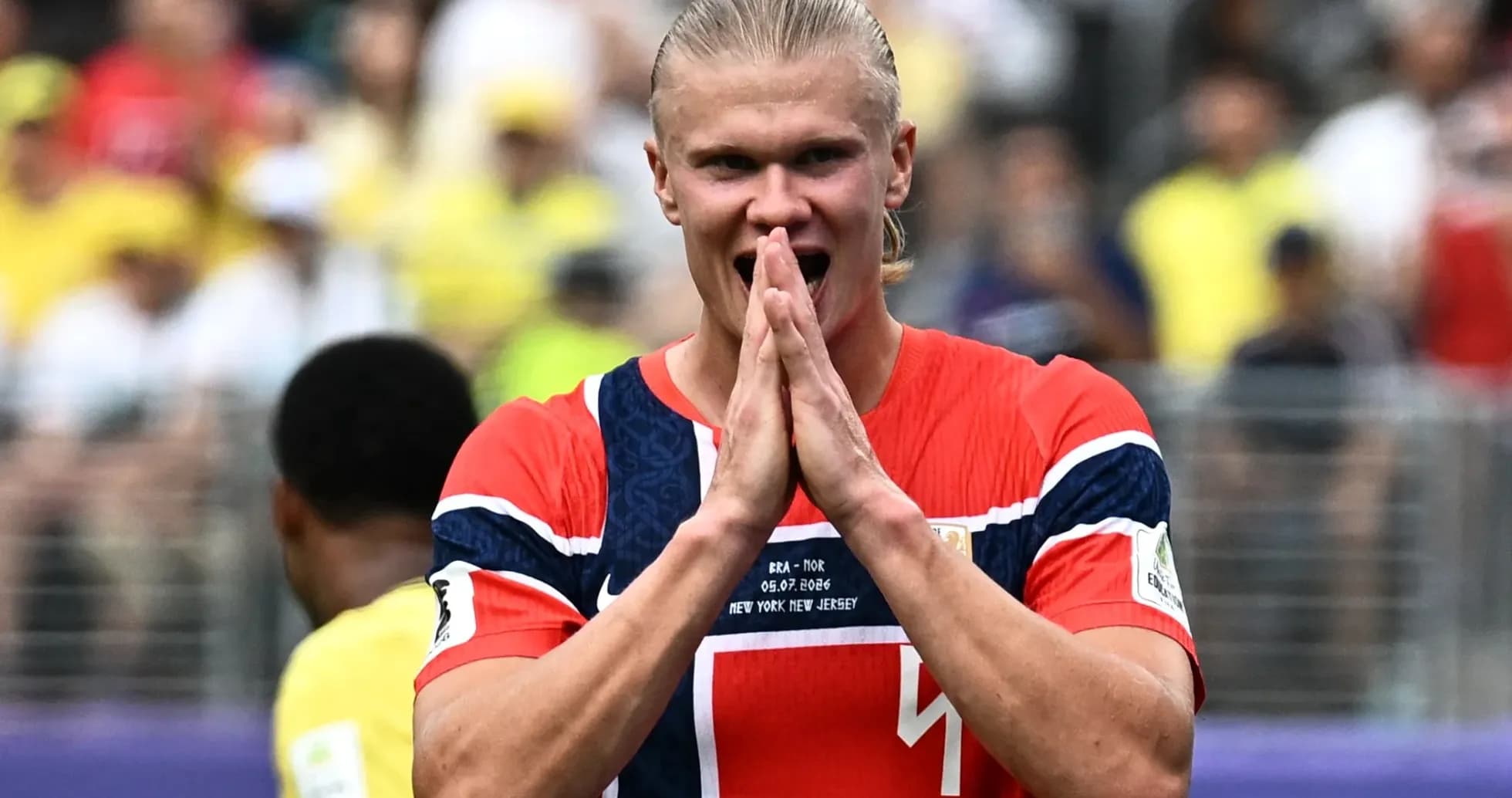
Erling Haaland should have crossed paths with Kylian Mbappé in the group stage, but Stale Solbakken chose to rest his star against France once qualification was secured. Haaland had already scored twice against both Iraq and Senegal. He then emerged from that enforced pause with a vengeance: the winner against Ivory Coast in the first knockout round, followed by both goals in a 2-1 victory over Brazil.
Seven goals in four appearances. Fourteen consecutive Norway games with at least one Haaland strike, 27 in that run. His overall record now stands at 62 in 54 caps. Those are video-game numbers.
He arrives in Miami one behind Mbappé and Lionel Messi in the Golden Boot race, and one ahead of Harry Kane.
Kane’s path has been more familiar, more methodical. Two goals in the opener against Croatia. One in the win over Panama that locked up top spot. Both goals in the late rescue act against DR Congo in the Round of 32. Then the penalty that proved decisive in the wild 3-2 victory over Mexico.
At 32, Kane is still churning out tournament-defining moments. Like Haaland, he has three Premier League Golden Boots and has proved himself in Germany. Yet they have only shared a pitch twice, in the 2022/23 season, when Tottenham Hotspur and Manchester City split a win apiece and both men found the net.
This feels like the rubber match, only with far more on the line. One of them could walk out of Miami not just closer to the Golden Boot, but with a fresh claim to being the most ruthless centre-forward on the planet right now.
The Dan Burn question: England’s unlikely Haaland plan
Stopping Haaland is a tactical puzzle that has beaten better teams than England. But Thomas Tuchel has a wild card.
Dan Burn.
On paper, it sounds fanciful. The 6ft 7in Newcastle defender only made his England debut just before turning 33 in March 2025. He has started four times for his country, all against Andorra and Albania in qualifying. His inclusion in this World Cup squad raised eyebrows.
Then came Mexico.
Thrown on for the final 15 minutes with England down to 10 men and clinging to a 3-2 lead, Burn turned the closing stages into his own personal siege. He attacked crosses, threw himself in front of shots, and helped drag England over the line through 12 agonising minutes of added time.
He is older and less mobile than Haaland, but he is also two inches taller and knows the Norwegian’s game from up close. Since Haaland joined Manchester City in 2022, they have shared more than 10 hours on a pitch together across eight matches in all competitions. Haaland has scored just once in that time, in their very first meeting in August 2022.
For a striker who averages a goal every 73 minutes in international football, that is not a coincidence England can ignore.
Ezri Konsa’s record against Haaland also tells a story: one goal conceded in 406 minutes across five matches, again in their first encounter in September 2022. Given Haaland has plundered 112 goals in 132 Premier League games over four seasons, winning the Golden Boot in three of them, those numbers are the kind that make a manager sit up.
The contrast with others is stark. Marc Guehi shipped seven goals to Haaland in five games before they became teammates at Manchester City. John Stones, of course, has never faced him in anger at all.
Tuchel must decide how much he leans into those Premier League scars and successes. Burn is unlikely to match Haaland stride for stride in the open field. But if England sit deep again and turn this into a game of penalty-box wrestling, the veteran could be the most important surprise of their tournament.
Odegaard vs Rice: a title-winning partnership turned fault line
If Haaland is the finisher, Martin Odegaard is the conductor. His performance against Brazil was one of the standout midfield displays of this World Cup.
Norway’s captain carried the ball forward 61 times and completed 101 of his 109 passes. Brazil, as a whole squad, managed only 331 passes and a far lower completion rate. Under his guidance, Norway reduced the five-time champions to just 33.6 percent possession, Brazil’s lowest share ever in a World Cup match.
That figure still edged England’s. Tuchel’s side had even less of the ball against Mexico, spending much of the final half-hour entrenched inside their own penalty area with 10 men. It was the lowest possession share England have recorded since such data has been tracked.
If they want to reach a first World Cup semifinal since 2018, and only a third since 1966, they cannot let Odegaard dictate like that again. Someone has to disrupt his rhythm.
No one knows Odegaard’s patterns better than Declan Rice. The pair have shared the Arsenal midfield 117 times over the last three seasons, leading the club to a long-awaited Premier League title and a Champions League final. Rice has seen Odegaard’s tricks, his angles, his triggers, from a few yards away every week.
The problem is Rice’s body.
He has been managing neural pain for months, a nagging issue affecting his lower back and hamstring. Odegaard will be fully aware of it. Rice still logged 3,094 Premier League minutes this season, with England partner Elliot Anderson playing even more. Odegaard, by contrast, played just 1,369 league minutes and comes into this World Cup with fresher legs.
That freshness could tilt the midfield balance. England need Rice to be sharp enough to close down space, strong enough to lean into duels, and fit enough to last. If he cannot, Odegaard will find the pockets he wants, and Haaland will not be far behind.
Miami heat: a different kind of test
The football is one thing. The weather is another.
Neither England nor Norway are built for humidity, yet both must now embrace it. Norway have at least had a more consistent taste of it across the tournament.
They opened in Boston against Iraq, then travelled to New York/New Jersey to beat Senegal. They went back to Boston for the defeat to France, when Solbakken rotated 10 players, before playing indoors for the only time so far against Ivory Coast in Dallas. The win over Brazil came back outside in the sticky conditions of New York/New Jersey.
England’s path has been kinder. They started under the roof in Dallas against Croatia, then played a rainy goalless draw with Ghana in Boston and a 2-0 win over Panama in New York/New Jersey, also in wet conditions. The Round of 32 victory over DR Congo came in the air-conditioned comfort of Atlanta. The Mexico clash in Mexico City, delayed an hour by a thunderstorm, was played in much cooler air.
Miami will be different. The two hottest games of the group stage were played here: Uruguay’s 2-2 draw with Cape Verde and 1-1 with Saudi Arabia.
Forecasts point to around 33°C (91°F) and 58 percent humidity at the 5pm local kickoff, with thunderstorms lurking. It will sap legs. It will punish pressing. It will expose any side that mismanages its substitutions or tempo.
The team that paces itself best, that drinks in the conditions rather than fights them, could be the one preparing for a semifinal on Wednesday night.
Norway’s left vs England’s right: a fault line in open play
One flank, in particular, looks primed for drama.
England’s right side has been patched together since Reece James limped out of the second group game against Ghana with a hamstring injury. With Tino Livramento already ruled out before the tournament, James is the only specialist right-back in Tuchel’s squad.
In his absence, the position has become a revolving door. Djed Spence, Ezri Konsa, John Stones and Jarell Quansah have all spent time there. Even Declan Rice dropped into that channel late on against DR Congo. Quansah’s red card against Mexico has taken him out of the equation for this quarterfinal.
James is pushing to return, which would be a significant boost given the opposition. If he does not make it, Konsa is the favourite to continue after impressing in England’s desperate rearguard against Mexico.
Whoever plays will face a very specific kind of threat.
Antonio Nusa, quick and elusive, loves to drive in from the left. His right foot produced one of the goals of the tournament so far: a curling strike into the top corner against Ivory Coast in the Round of 32. His cameos have been streaky but always dangerous.
Yet it was Andreas Schjelderup who truly tilted Norway’s last-16 tie. Introduced for Nusa at half-time against Brazil, the Benfica winger delivered his finest performance of the World Cup. His cross set up Haaland’s opener. Later, he teed up the same man on the edge of the box to lash in the second and kill the contest.
That rotation on Norway’s left – Nusa to stretch, Schjelderup to craft – will probe England’s most uncertain line of resistance. If James returns at something close to full capacity, England gain both defensive security and an outlet going the other way. If they have to improvise again, Norway will sense an opportunity to drag the game into that corridor and keep it there.
Miami promises heat, noise, and a clash of styles: England’s scarred tournament nous against a Norway side playing like it has nothing to lose. Somewhere in that chaos, between Haaland’s hunger, Kane’s relentlessness, Odegaard’s elegance and Rice’s resilience, a World Cup semifinalist will emerge.
The question now is simple: whose fairytale keeps going?