.svg&w=384&q=75 "Naijagoal logo")

Canberra United's Future: New Owners and Plans for Men's Team
Canberra United has lived on the brink for two years. On Friday, the club finally stepped away from the ledge.
Australian Sports Group (ASG) has bought the licence from Capital Football, securing Canberra United’s place in the A-League Women and setting a firm target: an A-League Men side in 2028-29.
For the first time since the club’s birth in 2008, United is in private hands. For many around McKellar Park, that shift feels less like a takeover and more like a lifeline.
McKellar at the heart of the plan
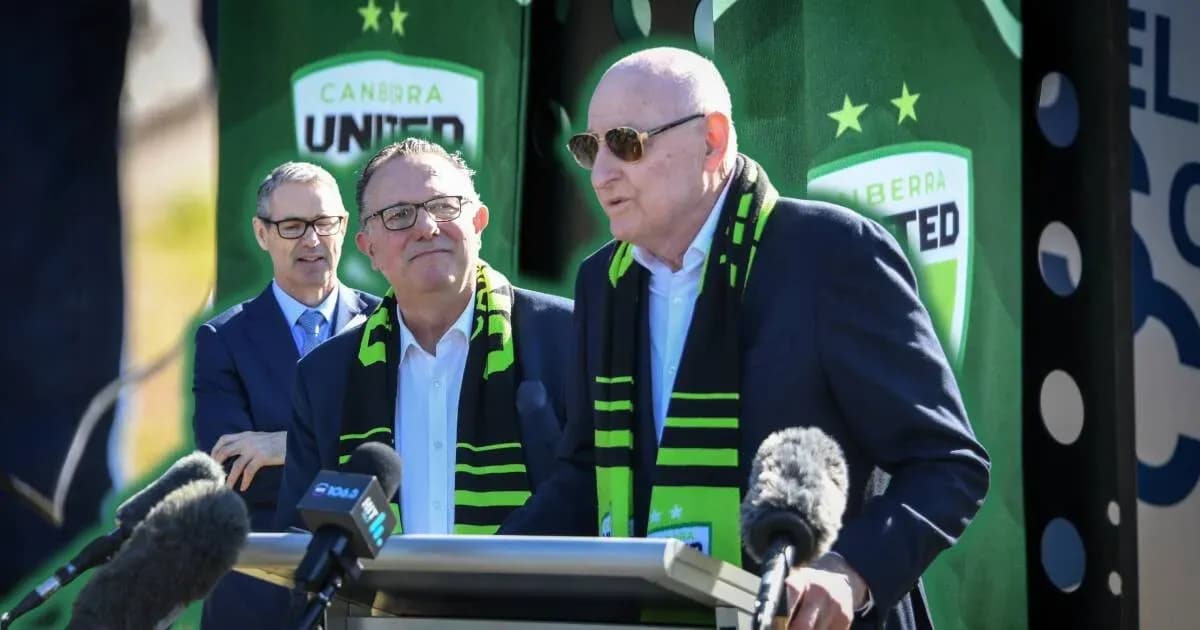
ASG chief executive Theo Fotopoulos and chairman Morris McAlister fronted up at McKellar Park to confirm what Canberra’s football community has been desperate to hear – United will play this coming ALW season.
McKellar, the club’s “spiritual home”, is not just staying on the fixture list. It is central to the new project.
ASG is exploring a purpose-built training base on the six-hectare site, while also locking in the neighbouring Belconnen Soccer Club as a “strategic partner”. The group will base its Canberra office there, anchoring the operation in the city’s north.
“It’s one of the few private grounds in Canberra. It’s roughly about six hectares,” Fotopoulos said, outlining the scale of what could be done at McKellar. He has already spoken with key stakeholders and likes what he’s hearing.
The ambition is clear: where Capital Football and the ACT government saw their Throsby Home of Football plan collapse under financial strain, ASG wants to step in and deliver a genuine home for elite football in the capital.
“Football needs a home and it’d be great to be able to develop that here,” Fotopoulos said. He also flagged that other sites around Canberra will be assessed, but McKellar is the obvious starting point.
Money on the table, questions kept close
Fotopoulos swerved direct questions about the price of the licence, but the broader deal is believed to sit at around $15 million, covering both the women’s side and the option for a future men’s team.
Crucially for the short term, ASG has committed to underwriting Canberra United to the tune of up to $3 million over multiple years. That guarantee is what allowed the A-Leagues to sign off on United’s participation for the 2026-27 ALW season after Capital Football’s finances reached breaking point.
The federation had carried the club since 2008. It could no longer afford to.
Coaching call and player rush
On the pitch, the clock is already ticking. Pre-season is just six weeks away. The A-League Women draw lands next month. The season starts on October 16.
ASG has moved early, speaking with current head coach Antoni Jagarinec, who has steered United into the finals in each of the last two campaigns. Fotopoulos made no secret of the fact continuity is the preferred route.
“It’s never a no-brainer, but yeah, look, I think [Jagarinec’s] results speak for themselves,” he said. “We’re looking for continuity and consolidation. We’ll have those announcements out pretty soon.”
The same urgency applies to the playing squad. The Professional Footballers Australia (PFA) is already in discussions with the players. ASG wants signatures on contracts quickly.
“That is our priority to get that finalised,” Fotopoulos said. “We feel very confident with the reaction we’ve had so far from the players that that will happen in haste.”
United’s rescue may have arrived late, but the new owners are determined the football department does not lose more time.
A men’s team – promise, not yet a licence
The other headline is the one Canberra has chased for almost two decades: a men’s A-League team.
ASG does not yet hold an A-League Men licence. What it has is an option – and a clear commitment – to enter a men’s side in 2028-29.
After 18 years of false starts, political wrangling and near-misses, another delay of three seasons will sting some. The expectation in recent months had been a women-first season followed quickly by a men’s team the year after.
Fotopoulos, though, left no room for doubt about the intention.
“Canberra is home to a thriving football community – a huge participant and passionate supporter base who have made Canberra United one of the most strongly supported A-League Women teams for the last 18 years,” he said.
He described the club’s future as a “twin strategy” built on both women’s and men’s programs.
“We believe the strength comes from both. It would be almost discriminatory not to work with the men. It’s always been part of our plans.”
APL chair Steve Conroy backed the move, calling ASG’s arrival “an exciting next step for professional football in the ACT” and a clear signal of the league’s belief in Canberra as a growth market.
For Canberra bid leader Michael Caggiano, who has pushed for a men’s licence for eight years, ASG’s entry may finally close a long and exhausting chapter. Auckland, announced as an expansion partner alongside Canberra almost three-and-a-half years ago, has already been in the competition for two seasons and is now champion. Canberra has been forced to watch on.
Now, at least, there is a date on the horizon.
United in name, open to a new identity
One thing ASG will not touch is the core brand.
“The name will remain the same, Canberra United,” Fotopoulos said. “You’ve got 18 years of Canberra United. Why would you change it?”
The badge, the colours, the United identity – they all stay. For both the women’s side and the planned men’s team.
What may change is the nickname. Fotopoulos wants the city to help define the club’s next era, floating the idea of a public campaign, potentially run through The Canberra Times, to find a moniker that sticks.
The Cosmos. Arrows. Greens. Lakers. Or something no one has thought of yet. The door is wide open.
“If the Canberra community want a nickname for their team, Green Machine, whatever they come up with, we’re happy to look at that,” he said.
Pathways rebuilt, infrastructure promised
ASG is not just talking about first teams. Fotopoulos has committed to re-establishing academy pathways in Canberra after Capital Football controversially shut down United’s academy three years ago.
“We’re excited to be part of growing the A-Leagues and building a strong club focused on community engagement, football excellence, commercial growth, new infrastructure and strengthening the football development pathways for boys and girls in the territory and the capital region,” he said.
That promise cuts to the heart of the club’s long-term value. United has always been more than a matchday ticket in Canberra; it has been a symbol that local juniors, especially girls, could dream beyond community football.
With ASG in charge, those pathways are set to return – backed by plans to invest in facilities and a more professional environment.
The men behind the move
The faces fronting this shift are not new to Australian football.
ASG chairman Morris McAlister comes from a commerce background and is the governing director of Petron Plus 7 Australian and New Zealand, a company dealing in engine and machine products such as lubricants and grease. He also serves as senior consultant at MEC Team Consultants, a firm that links Australian businesses with markets in China.
Fotopoulos is a marketing executive and chief executive of FOS Group Australia. He has worn football suits before – chief executive at Sydney Cosmos and Sydney Olympic, and involved with Newcastle Breakers in the old NSL.
This is not a speculative punt from outsiders. It is a calculated move by people who know the sport’s sharp edges and still want in.
They now have two years to lay the foundations of a men’s team and only weeks to lock in a women’s squad and coaching set-up before the next ALW campaign kicks off.
For a club that has lived season to season, that kind of runway is a luxury. What Canberra does with it will define whether this is just a rescue, or the start of a genuine football powerhouse in the capital.