.svg&w=384&q=75 "Naijagoal logo")

Canada's World Cup Journey: A New Era for Football
Canada, the “forgotten host” that refused to be ignored, walks away from this World Cup with something far more enduring than a line on a tournament poster. It leaves with a landmark run, a country briefly united around a team that tore up its own history book.
Jesse Marsch’s side did not just turn up. It pushed through the group, scrapped its way into the round of 16 for the first time ever, and only then bowed out to Morocco. Along the way came a first World Cup point, a first win, and then a first knockout victory. For a program that had long lived on the periphery of the men’s game, this was a leap, not a step.
“They shocked everyone,” said fan Matt Lorincz in Calgary. He meant the wider football world. The truth is, they shocked a fair chunk of Canada too.
A Hockey Nation Finds Its Football Voice
In a country where football is the most-played sport but rarely the loudest, the last few weeks felt different. Ice hockey still rules the cultural roost, and major-league baseball and basketball soak up the commercial glare. Yet from June into July, football muscled its way into the national conversation and stayed there.
“Most people you talk to watch, like, hockey or other sports,” Lorincz said. “There’s not a lot of – or as many – soccer fans in Canada. So hopefully there may be a few more of those.”
The hope is that this tournament becomes a turning point, not a one-off. For a brief window, the World Cup soundtrack replaced the usual noise. In Toronto, commentary spilled from bar doorways into the streets. Supporters in red marched in noisy, colourful clusters through downtown to Toronto Stadium. On the west coast, Vancouver rode the wave of a 6-0 demolition of Qatar, a statement win scarred only by the sight of Ismaël Koné leaving on a stretcher with a broken leg after a heavy challenge.
Canada’s chapter as co-host closed in Vancouver, where Switzerland beat Colombia in the round of 16. The football moved on. The impression lingers.
A Prime Minister in the Dressing Room
No one leaned into the moment quite like Prime Minister Mark Carney. A self-confessed sports obsessive with a jersey for almost every occasion, he has been the only leader among the three host nations to show up in the stands. For him, this was not just about football; it was about staging Canada on the world’s biggest sporting platform.
After that 6-0 win over Qatar, Carney went straight into the dressing room in Vancouver and addressed the players.
“You showed a level of character that some people never achieve in their life,” he told them. “And you showed it when a good part of the country and the world is watching.”
Sports minister Adam van Koeverden framed the whole experience as a coming-of-age moment for a so-called “middle power,” calling the chance to host “a sincere privilege that we have not taken lightly.”
The bid, as John Kristick remembers it, was built on the slogan “one continent, three countries.” Kristick, a sports marketing executive with Playfly Sports Consulting and executive director of the original United Bid Committee, believes the tournament has largely delivered on spectacle, but not always on that united ideal.
He sees Canada and Mexico fighting harder for oxygen. “I think it’s probably been harder for Canada and Mexico to break through as hosts. I think that the US have taken more of that limelight,” he said, citing both American politics and the sheer volume of games staged south of the border.
On Canadian streets, though, the message has landed. “Every Canadian knows Canada is hosting it,” Kristick said. “And I think there’s been a great deal of national pride.”
Toronto and Vancouver staged 13 of the World Cup’s 104 matches. It was enough to change the rhythm of daily life.
The World Cup Hits the Till
In British Columbia, restaurant and bar owners got a crash course in what a World Cup really means. “The enormity of the World Cup,” is how Ian Tostenson, head of the British Columbia Restaurant and Foodservices Association, described it.
The effect was tangible. Bars filled, screens glowed from lunchtime to late night, and alcohol sales climbed about 5% compared with last year. “It raised the spirits of the entire province,” Tostenson said. “I think the whole conversation [for the] last four weeks had been about soccer.”
Canada is not immune to economic headwinds. That, Tostenson argued, made the lesson sharper: “You learn that if you give people a real reason to spend their money and give them value, they’ll spend it.”
The bill for that party has drawn its own scrutiny. Taxpayers put up an estimated C$1.1bn to prepare for co-hosting, with Toronto alone on the hook for about C$380m. For City Councillor Josh Matlow, those numbers do not square with a city already wrestling with strained finances.
“I don’t think that hosting the games made the city’s situation any better,” he said bluntly.
Van Koeverden pushed back, calling the investment “prudent” and pointing to the money cycling back through the economy. “Full stadiums, full parks, full restaurants, and full hotels is a nice problem to have in 2026,” he said.
For now, business owners who rode the wave would not argue with that.
A “Forgotten” Host That Won Over Visitors
Canada may have been overshadowed on the global broadcast map, but those who came left impressed. Portugal manager Roberto Martinez praised Toronto’s compact ground, the smallest of the World Cup venues and bulked up with temporary seating, saying it reminded him of “old-fashioned Premier League grounds.” After Portugal beat Croatia there, he called the spectacle “an incredible spectacle for football.”
From the stands, the charm was obvious. Norwegian fan Gudmund Agotnes, in town for three matches, felt he had lucked out with the draw. He loved the “bird’s eye view” his seat offered of both the pitch and the Toronto skyline. “Pretty cool,” he said, with the understatement of a man who knew he’d picked the right trip.
The numbers underline that sense of occasion. Across the three host nations, more than a million fans attended the opening 16 games, according to Fifa. The tournament is on track to pass the all-time cumulative attendance mark of 3.5 million set in 1994, though the expanded format makes that surge less surprising.
What stands out in Canada is the audience at home. The last-16 clash with Morocco on 4 July peaked at 11.7 million unique viewers, Bell Media said – the biggest non-final World Cup figure ever recorded in the country. By comparison, 9.8 million Canadians tuned in for the opening night of the NHL season last October.
Round-of-32 matches averaged 1.9 million Canadian viewers. Hockey Night in Canada, a staple of the sporting calendar, usually draws around 1.2 million. For a few weeks, Les Rouges nudged hockey off centre stage.
Building a Football Future
Canada is no stranger to the sport. The Vancouver Whitecaps, founded in 1973, and Toronto FC, established 32 years later, have long flown the flag in Major League Soccer. Grassroots participation is strong. The women’s national team sits ninth in the Fifa rankings.
The missing piece has been sustained excellence on the men’s side. This World Cup run does not fix that overnight, but it changes the starting point.
Canada Soccer, the governing body, has already felt the surge. A fundraising drive launched before the tournament hit its C$25m target months ahead of schedule, a windfall that would have seemed ambitious not long ago.
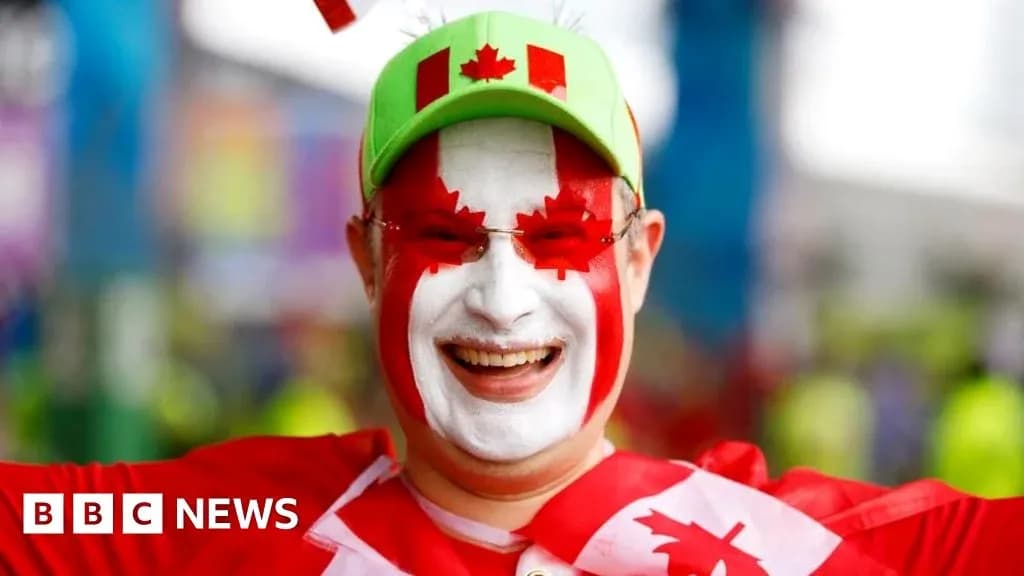
In the stands and in bars, the shift is more emotional than financial. Fans of Les Rouges are still basking in the glow of a team that finally matched their dreams with deeds.
“It brought a lot of people together in a very kind of segregated world that we’re living in,” said Zeileen Reardon, watching the Morocco match in a Calgary bar. “So, I think it actually showed the world that we can come together, even for a game.”
For a “forgotten host,” that may be the most powerful legacy of all: a country that briefly saw itself in a different jersey, on a different stage, and liked what it saw enough to want more.