.svg&w=384&q=75 "Naijagoal logo")

Canada's First World Cup Win Marred by Koné's Injury
Canada finally had its World Cup moment. A first-ever victory on the biggest stage, a ruthless 6–0 dismantling of Qatar in Vancouver, a Jonathan David hat trick to light up Group B.
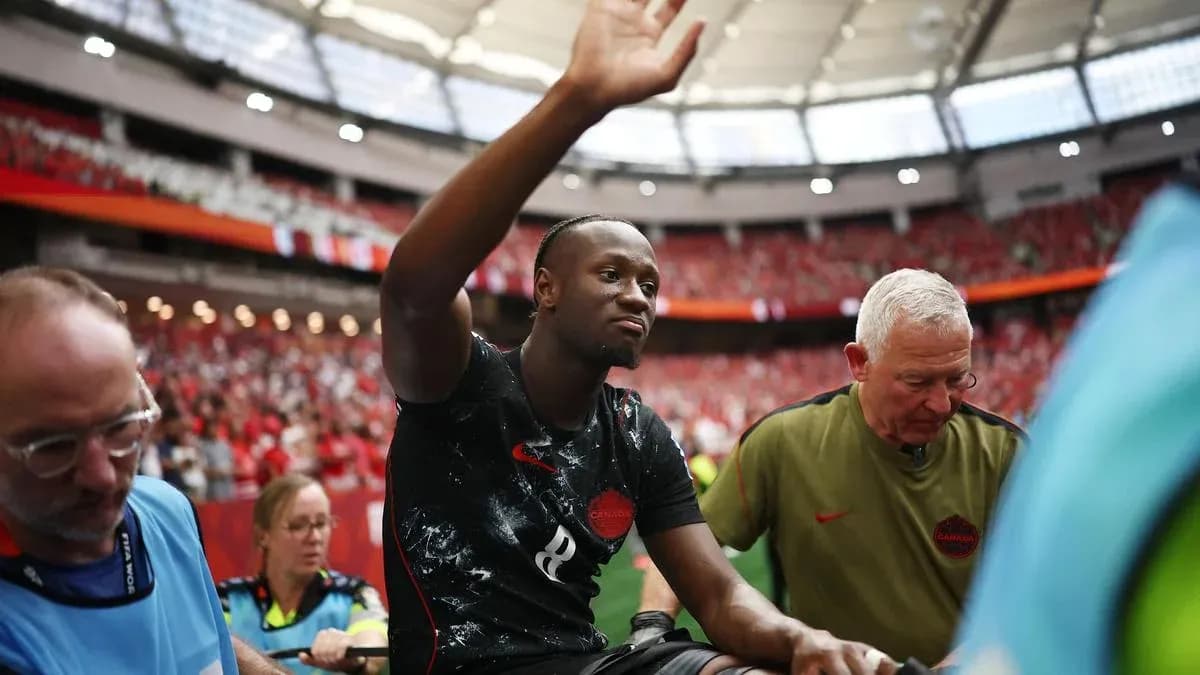
And yet, as the crowd roared and the goals kept coming, the image that will linger is Ismaël Koné lying on the turf, his teammates forming a human shield around him.
A night that turned in an instant
The match had long tilted Canada’s way when it lurched into something far darker in the second half. Koné took a pass, turned, and Qatar midfielder Assim Madibo came through him from behind. The 24-year-old went down immediately, clutching his left leg.
Players knew before the medics did.
Stephen Eustáquio sprinted over, then froze. The Canada captain later admitted what he saw was enough to chill anyone on the pitch: “I saw his leg. I saw that something wasn't right.”
Others waved frantically to the bench. Koné’s face twisted in pain. Around him, red shirts closed ranks, blocking the view from the stands and the cameras as medical staff rushed on.
The tackle left no debate. Madibo was shown a straight red card, Qatar reduced to nine men after Homam Ahmed’s earlier dismissal in the first half. Koné was treated on the field, then stretchered away to a subdued ripple of applause that felt more like a vigil than a send-off.
Bones, silence, and a shaken bench
From the technical area, Canada coach Jesse Marsch had the worst possible vantage point.
He said the collision happened “right in front of the bench,” close enough that players and staff heard what no one ever wants to hear in a stadium: the sound of “bones snap.”
Koné was taken straight to a local hospital. Marsch confirmed he was preparing for surgery, surrounded by family, as the match played out without him.
On the touchline, Canada’s staff tried to steady a group that had just watched a teammate suffer what appeared to be a serious lower-leg break. On the field, the players had to keep going.
“Everybody was crushed when it happened, but we had to find a way to stay focused, we knew that Ismaël wanted us to finish the job,” Marsch said. “There's a lot of thoughts that go through our heads right now, we're all thinking about him, but we're all very proud of what we are.”
Marsch added that Madibo had personally apologized to Koné, a gesture that may soften intent but cannot erase the impact.
The exact diagnosis has not yet been disclosed, but images from the incident showed Koné’s lower left leg visibly distorted. No one in the Canada camp is under any illusion: this is an injury that will define his year, and possibly Canada’s tournament.
Saliba’s tribute, David’s anger
Football, ruthless as ever, did not stop.
With Qatar down to nine, the spaces opened up. Less than 10 minutes after Koné left the field, his replacement, Nathan Saliba, arrived perfectly in stride to score Canada’s fourth goal of the night.
The celebration told the story. Saliba didn’t sprint to the corner flag or beat his chest at the crowd. He reached for Koné’s jersey, held it aloft, and pointed to the name. The stadium responded with a roar that sounded less like joy and more like defiance.
At the sharp end, Jonathan David was merciless. The striker helped himself to a World Cup hat trick, a landmark performance on a landmark night, but his mood after the final whistle was anything but light.
He questioned why the tackle had happened at all.
“If there's a play where you cannot win the ball, there's no point,” David said. “It's just to hurt people.”
In a game already under control, with Qatar chasing shadows and Canada cruising, the challenge felt needless to those in red. David’s words captured that anger.
History, but at a cost
Strip away the emotion and the scoreline is emphatic. Canada, long cast as World Cup outsiders, finally have a win to their name — and they did it in style. Six goals, a hat trick from their star forward, and a statement to the rest of Group B.
Yet every conversation after the match circled back to the same subject: Koné.
Eustáquio, who had sounded so composed in the buildup to the tournament, did not hide how much his midfield partner means to this team.
“We're going to miss (Koné),” he said. “He has that X factor that our team really needs.”
Canada left the pitch with three points, a surging goal difference, and a place in World Cup history. They also left with a hole in the heart of their midfield and a dressing room thinking less about tactics and more about a teammate in a hospital bed.
The country finally has its first World Cup win. The question now is how far this team can go without the player who so often made them believe they belonged here in the first place.