.svg&w=384&q=75 "Naijagoal logo")

Brazil's World Cup Exit: Ancelotti's Misguided Gamble
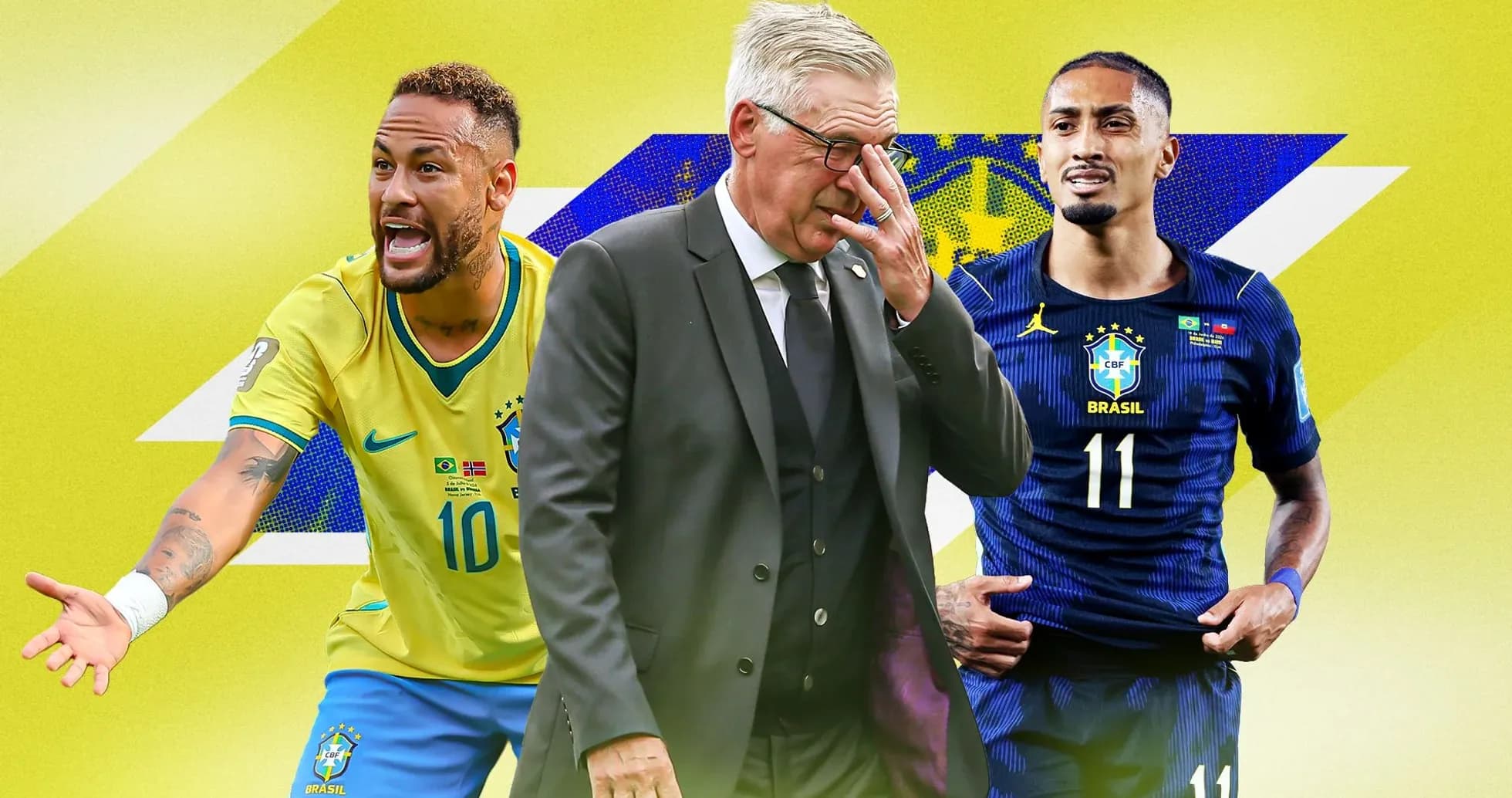
Brazil’s World Cup crash was years in the making. The inquest, though, starts with one man and one stubborn idea: Carlo Ancelotti’s belief that the old guard could carry them one more time.
He was wrong.
An ageing spine creaks and collapses
Brazil arrived with a squad that looked more like a testimonial lineup than a team built for a month of high-intensity football.
Three goalkeepers: 33, 32 and 38. A defensive unit averaging 31, with Danilo and Alex Sandro – once elite, now symbols of a cycle that should have ended long ago – still entrusted with the flanks. In midfield, Casemiro, 34, again asked to anchor and inspire. Fabinho, 32, handed meaningful minutes as if the clock had stopped five years ago.
There were glimmers of tomorrow. Bournemouth’s 19-year-old Rayan and Botafogo’s 25-year-old Danilo offered hints of renewal, flashes of the energy this team so badly lacked. Ancelotti admitted it himself after the exit: Brazil need new blood, and fast.
“We need some young talent, we need some high-level players coming into Brazilian football,” he said. The message was clear. The squad wasn’t.
Neymar: the nostalgic gamble that backfired
Nothing summed up the confusion quite like Neymar.
At 34, with his last cap in October 2023 and a body that has betrayed him too often, his recall was driven as much by noise as by logic. Media pressure. Fan nostalgia. The myth of the saviour.
Then reality struck. On the eve of the World Cup, a calf injury. “Two to three weeks” out. He missed the first two group games, scraped together just 14 minutes against Scotland in the third. Those minutes in Miami felt less like a comeback and more like a farewell tour, the pace of the game a step ahead of him.
When knockout football arrived, Ancelotti’s trust evaporated. Neymar stayed on the bench throughout the dramatic last-32 win over Japan. Against Norway in the round of 16, with Brazil chasing the game, he finally got more time – and still looked a shadow, his late consolation penalty doing little more than dress the scoreline. It felt like an international swansong, not a statement.
And it left one decision looking even worse.
The Joao Pedro question that will not go away
If Neymar was the romantic choice, Joao Pedro was the rational one. He stayed at home.
The Chelsea forward, 24, came off a debut season at Stamford Bridge with 29 combined goals and assists. Form, versatility, and the profile of a modern No.9. By the time the squad announcement neared, it was almost assumed he would not only travel, but possibly start.
Ancelotti even conceded, publicly, that Pedro “probably deserved to be on this list.”
He still cut him.
When Neymar broke down and Brazil lacked a mobile, in-form striker who could threaten in behind, link play, and offer something different, that omission became unforgivable in the eyes of many. Brazil icon Ronaldo Nazario didn’t bother to sugar-coat it.
“I have to be honest, I think this elimination begins with the decisions from the bench,” Ronaldo said. “I still don’t understand why Joao Pedro was not part of this squad. He has had an exceptional season, he is in form, and Brazil needed a striker who could offer something different.”
The words will echo around every post-mortem.
Midfield left exposed
The squad choices hurt Brazil most in the one area you cannot compromise at a World Cup: midfield.
Ancelotti initially named just five central midfielders, one of them Lucas Paqueta, who is more of a No.10 than a controller. Only later did Manchester United-bound Ederson arrive as a late replacement for injured right-back Wesley, a reshuffle that underlined how little balance there was to begin with.
Into that vacuum stepped Bruno Guimaraes. The Newcastle captain carried the load, tasked with creating and grafting in equal measure. Four assists told one part of the story; the other was written in the spaces around him, where support never truly arrived.
Ederson and Danilo barely saw the pitch. Ancelotti clearly did not trust his alternatives, and Brazil’s midfield became a one-man engine room.
After the loss to Norway, the coach did not hide from the problem: “We have to think about the future, but it is very evident that in the midfield, I think that we have to move some players.”
He will have to. This tournament exposed a structural flaw, not just an off day.
Data, pressure and a missed penalty
One moment will be replayed over and over: the first-half penalty against Norway.
Score it, and the narrative might tilt. Miss it, and it becomes a symbol. Brazil missed.
When Bruno Guimaraes stepped up, eyebrows rose. Vinicius, the team’s leading scorer at the tournament and in electric form, stood aside. Many expected him to take the responsibility. He didn’t.
Ancelotti later explained that the choice was dictated by numbers, not instinct. “We did statistics for the players and according to that, Raphinha was the best option,” he said. “The best person would be Raphinha and then Neymar [who weren’t on the pitch], and after that, Bruno Guimaraes. After Bruno, it would be [Gabriel] Martinelli, so we chose Bruno Guimaraes as we felt he would be the best.”
On paper, it made sense. On the pitch, in the weight of the moment, it backfired. Norway seized the momentum, took the lead, and Brazil never truly recovered.
Injuries and the thinness of the squad
Ancelotti is not wrong when he points to the injuries. They were brutal, and they were decisive.
Before the squad was even named, Eder Militao, Rodrygo and Estevao Willian were ruled out. A starting right-back gone. Two wide players capable of changing a game gone. For a team already clinging to veterans, those absences cut deep.
The tournament brought more damage. Neymar’s calf, predictably, gave way. Raphinha pulled up in the first half against Haiti in the second group game and never played again. Paqueta, vital between the lines, limped out at half-time in the knockout tie with Japan.
Piece by piece, Brazil’s attacking structure crumbled. What remained was a tired core, asked to do what their legs could no longer guarantee.
Ancelotti could argue that no coach survives that level of attrition unscathed. He has a point. But it does not erase the fact that his initial squad left Brazil with too little margin for exactly this kind of bad luck.
The start of something, or the end of an era?
For Ancelotti, this failure is being framed as a beginning, not a conclusion.
“A defeat is the beginning of a new adventure,” he said. “We have to keep improving, to find new ideas. It is not an end, it is the start of a new cycle.
“We will manage this defeat by bringing a fresh impetus to our work and the assessment of the players. We will try to improve and look for new ideas. The same as we did this year.
“I think the work we've done has been good. Football is like this; sometimes you have to manage the sadness of a defeat. I am used to this.”
He may be used to it. Brazil are not.
The five-time champions now stand at a crossroads, weighed down by loyalty to legends and haunted by the talent they left at home. The next squad list will tell its own story: will Ancelotti finally cut the cord with the past, or will Brazil walk into another tournament carrying the same ghosts?