.svg&w=384&q=75 "Naijagoal logo")
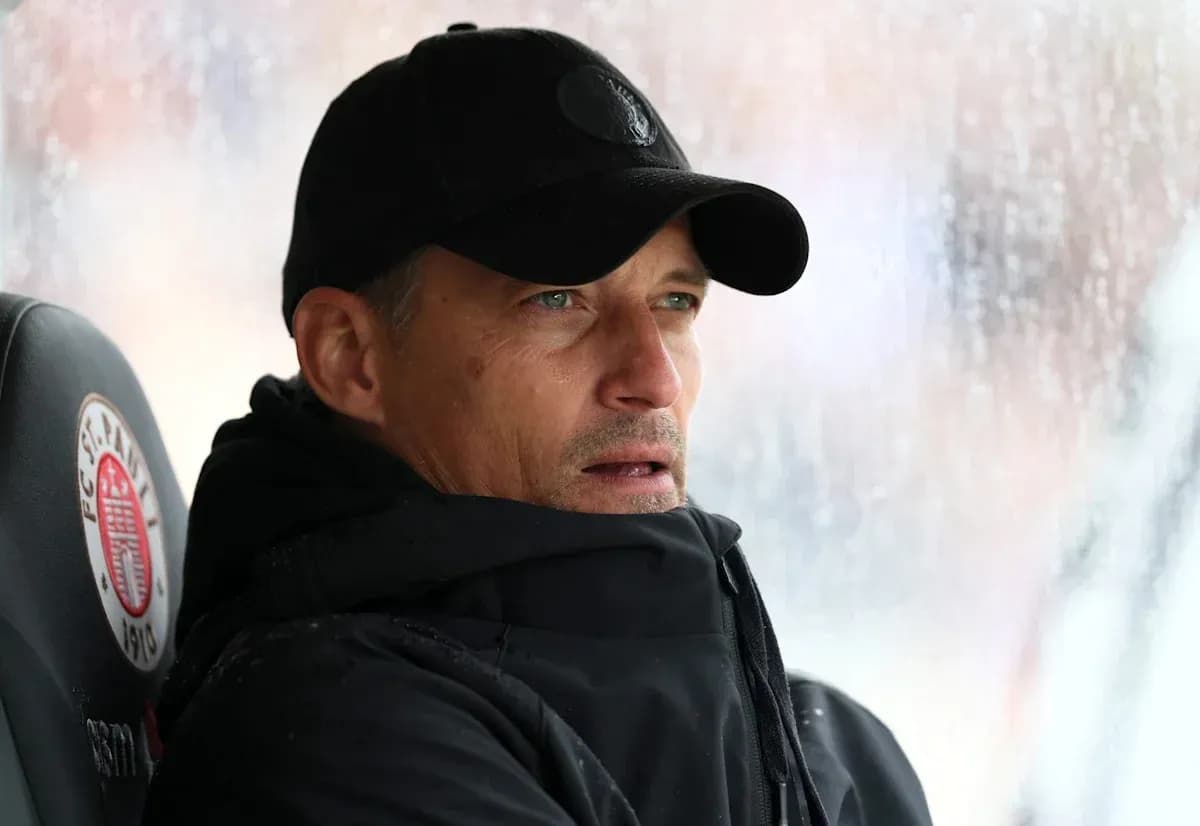

Borussia Mönchengladbach Appoints Alexander Blessin Amid Crisis
Borussia Mönchengladbach have turned to Alexander Blessin to drag them out of a deep early-season crisis, handing the 53-year-old a contract until 2028 and a daunting rescue job in a club short on points, stability, and defensive structure.
He will be presented on Wednesday alongside sporting director Rouven Schröder. The work starts now.
From 5-0 humiliation to a new man in charge
Blessin replaces Eugen Polanski, who paid the price for a brutal 5-0 thrashing at Freiburg on Matchday 3. That defeat ended Polanski’s spell just over a year after he stepped up, another short chapter in a coaching carousel that has spun relentlessly since Marco Rose left for Borussia Dortmund in 2021.
Jan-Moritz Lichte took over on an interim basis and at least injected some attacking life into a team on its knees. Saturday’s 3-4 home loss to Mainz still yielded zero points, but it did leave the incoming coach with something to work with going forward: a side that can score, if not yet one that can defend.
The table tells the rest of the story. Gladbach hit the international break rock bottom in the Bundesliga, with a 6:16 goal difference. Only Union Berlin have shipped more goals; the 16 conceded equal the worst defensive record in league history after four matchdays.
Blessin walks straight into that storm. His debut? A Rhine derby away at 1. FC Cologne on October 11. No gentle introduction.
A swift return after the fall with St. Pauli
Blessin’s comeback to the Bundesliga comes only four months after relegation with FC St. Pauli, a drop that masked the complexity of his two-year spell in Hamburg.
He arrived there with momentum. After eight years in RB Leipzig’s academy, he made his name at KV Oostende and Union Saint-Gilloise, lifting the Belgian Cup and twice being named Coach of the Year in Belgium. That résumé persuaded St. Pauli to hand him the reins following promotion in 2024.
His first Bundesliga season on the Kiez was impressive. St. Pauli became one of the most awkward sides in Germany to break down, conceding only 41 goals – second-best defensive record in the league behind Bayern Munich – and securing survival with a disciplined, compact approach.
That work did not go unnoticed. In April 2025, Get German Football News reported that Hoffenheim and Wolfsburg were monitoring Blessin as he steered St. Pauli away from danger. The following campaign even started like a breakthrough year: unbeaten after three games, seven points on the board, and a September GGFN tactical analysis dissecting a high-flying side near the top of the table.
Then the floor gave way.
A nine-game slide and a season unravelled
A nine-match losing streak dragged St. Pauli straight into a relegation fight. Blessin stayed in the job through mounting pressure and briefly seemed to have found another escape route. Wins over Werder Bremen and Hoffenheim, plus a draw with Eintracht Frankfurt, delivered seven points from three games and a hint of recovery.
By mid-March, when GGFN published its detailed “Relegation Check” after a 2-0 loss in Gladbach, the situation remained dangerous but not hopeless. Performances such as a 2-1 win over Stuttgart suggested there was still enough resilience and energy in the squad to survive. Blessin had repeatedly squeezed results from a limited group.
Then came the decisive collapse.
St. Pauli threw away a lead and lost 2-1 to Freiburg. In the aftermath, Blessin apologized for insulting referee Florian Badstübner during an emotional post-match interview, a sign of the strain building around the club. A 1-1 draw at Union Berlin followed, before Bayern rolled into the Millerntor and tore the Kiezkicker apart 5-0.
A 1-1 draw with Cologne offered only brief respite. The crucial blow landed against bottom side Heidenheim: a 2-0 defeat in one of St. Pauli’s clearest remaining chances to climb out of the drop zone. By then, as GGFN pointed out, Blessin’s team had taken just two points from five matches since that relegation analysis.
The slide continued.
St. Pauli lost 2-1 to Mainz, then 2-1 again at RB Leipzig, leaving their fate hanging on a final-day home showdown with Wolfsburg. They lost that too, 3-1 at the Millerntor, and finished bottom of the Bundesliga. From mid-March to the end of the season, they collected only two points from eight matches and never won again.
The club chose to start over without him after relegation.
Gladbach gamble on structure and scars
Gladbach, though, are betting that the coach who built one of the league’s best defensive units in his first St. Pauli season is closer to the “real” Blessin than the man who went down with a broken team months later.
They are also betting on experience. Blessin has worked in Germany, Belgium, and Italy, guided Union Saint-Gilloise to silverware, and spent nearly a decade shaping players in Leipzig’s academy. He understands systems, youth development, and how to weld a squad into a compact block. Right now, Gladbach need all of that.
The dugout at Borussia-Park has been anything but stable. Since Rose left in 2021, Adi Hütter and Daniel Farke each lasted just a single season. Gerardo Seoane survived from June 2023 to September 2025. Polanski’s reign ended after a little over a year. Blessin now becomes the club’s fifth permanent head coach in that turbulent stretch.
He inherits a team still searching for its first point, a defence leaking goals at a historic rate, and a fanbase tired of false starts. He also inherits an international break – a rare window of calm – to drill his ideas into a fragile squad before stepping into one of the most emotionally charged fixtures on the German football calendar.
A new plan, a new voice, a derby away from home. For Alexander Blessin and Borussia Mönchengladbach, the margin for error is already gone.