.svg&w=384&q=75 "Naijagoal logo")
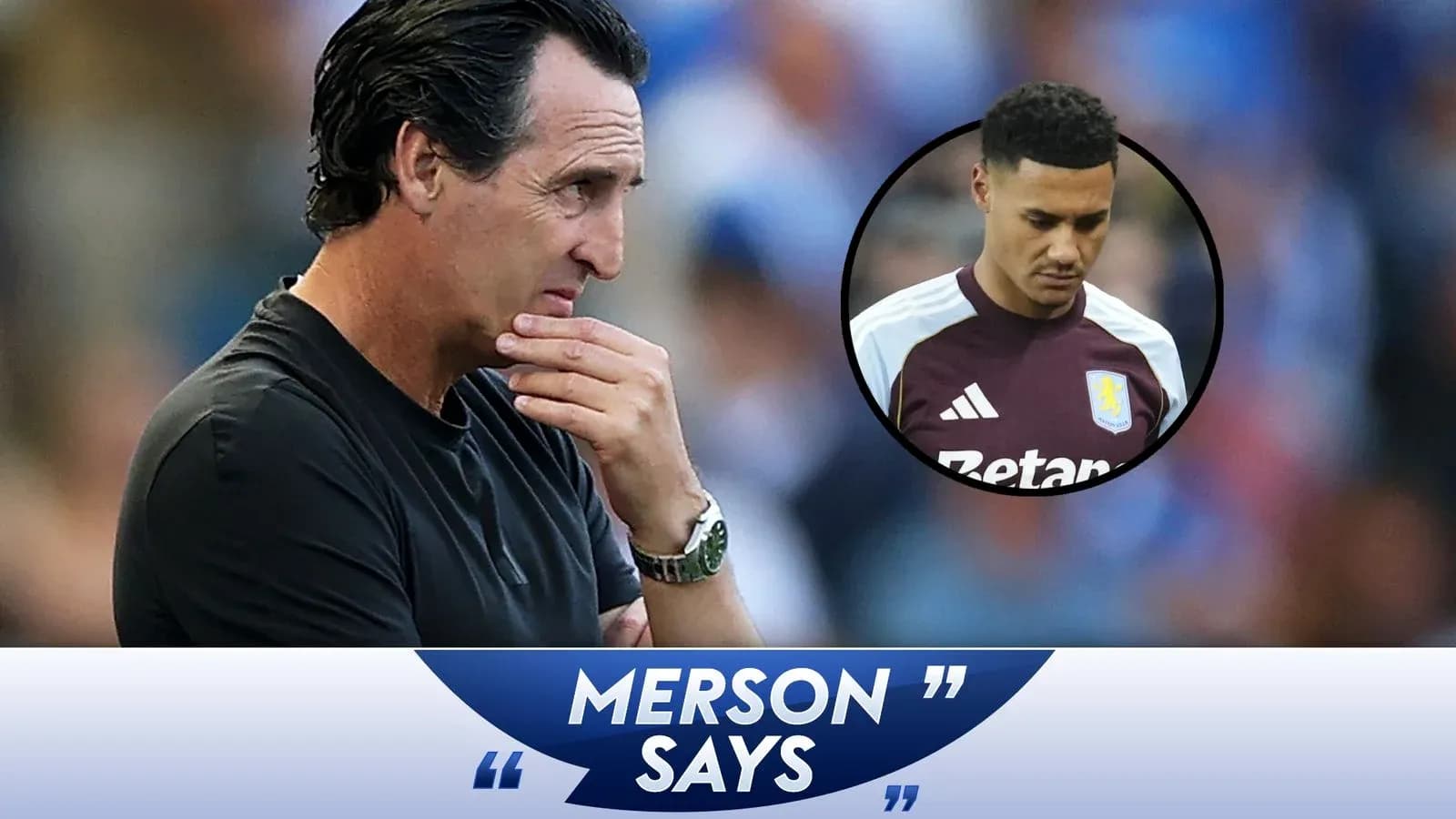

Aston Villa's Dismal Decline: Merson Questions Emery's Future
The numbers on the scoreboard at Brighton were brutal enough. Four down inside half an hour, beaten 4-0, and looking every inch a side stripped of its core. For Paul Merson, watching his former club unravel like this is more than just a bad day at the office. It hurts.
This is a team that climbed into the Champions League, lifted a European trophy, and then, in his eyes, ripped out its own spine.
Ezri Konsa. Youri Tielemans. Morgan Rogers. All gone in the same summer. Against Brighton, the consequences were laid bare. Villa were 4-0 down after 30 minutes and never recovered.
“You sell all your best players, what do you expect?” is Merson’s blunt verdict in his latest Sky Sports column. He didn’t fancy Villa to beat Brighton, but he didn’t see them being blown away quite so quickly either. The scale of the drop-off, given where Villa were just a few months ago, leaves him staggered.
This isn’t some mid-table side drifting. This is, as he stresses, “a big, big football club” that had just punched its way back into Europe’s elite. To Merson, the way they have dismantled that momentum is “madness at the highest level”.
Emery’s Future Under the Microscope
Unai Emery, the architect of Villa’s resurgence, suddenly looks like a man being asked to build a cathedral with the scaffolding kicked away. Merson is adamant: he cannot see this ending well if the current trajectory continues.
He doesn’t expect Villa to be dragged into a relegation fight. The squad, even after the sales, should have too much for that. But a top-half finish? He no longer sees it, not even with a coach he calls “one of the top managers in the game”.
And that’s where his concern sharpens. If Emery isn’t already fed up, Merson says, “then he’s some person.” Top managers do not usually hang around when their best players are sold from under them. He points to history: when Spurs won a European trophy and collapsed to 17th, Emery took the same trophy with Villa and finished fourth. That contrast underlines the scale of his achievement — and how quickly it is being put at risk.
Now, as Merson sees it, everyone is “leaving him left, right and centre”. For a club of Villa’s stature, one he calls “a great, great club” and one he proudly represented, that is a betrayal of hard-won progress. They fought their way to the “promised land” of Champions League football, then chose this moment to sell “everyone that’s top drawer”.
Release Clauses That Baffle a Club Legend
If the results sting, the deals behind the departures infuriate him. The Youri Tielemans contract, with its £36m release clause, is a particular flashpoint.
“Whoever did that contract… should be under scrutiny,” Merson says. In a market where clubs battling to finish fourth-bottom are paying around £35m for players, letting one of the country’s standout midfielders go for that kind of fee is, to him, staggering. He calls it “the deal of the century” — just not for Aston Villa.
Tielemans now has to prove himself at Manchester United, but from a Villa perspective, Merson sees the clause as indefensible. You simply “can’t put a clause in that says £35m for one of the best midfield players in the country.”
The Konsa sale cuts just as deep. An England international centre-half, fresh from a World Cup, leaving for £55m. Merson doesn’t dress it up. “It’s sad,” he says. These aren’t just sales; they’re symbols of a club squandering a moment that should have been about consolidation and ambition.
Watkins Storm: ‘Disgusting’ If He Refused to Play
Then there is the Ollie Watkins situation, which sends Merson into outright fury. The striker was not involved at Brighton amid heavy interest from Saudi Arabia. Reports have suggested he was fit to play but did not make himself available. If that is true, Merson’s verdict is scathing.
“Disgusting at the highest level,” he calls it.
He goes straight to the heart of the player-fan contract. Supporters in the Holte End pay big money for season tickets, for travel, for the right to follow their club up and down the country. In return, they expect the basics: that their centre forward, richly rewarded and living the dream of millions, makes himself available when he is fit.
“You’ve got the best job in the whole wide world,” Merson reminds Watkins. Premier League striker, centre forward for Aston Villa, “earning fortunes”, being paid to stay fit. He accepts that Saudi interest can turn a player’s head, especially one who is “not a spring chicken anymore”, but he refuses to accept that as an excuse to sit out.
“You have to want to play football,” he insists. Every fan in that stand “will give their right arm” to be on the pitch in that shirt. To choose not to play, if fit, is unforgivable in his eyes.
Merson goes as far as to say Watkins should apologise if he did refuse to play. He questions what the striker gains from that stance and argues that Villa should hit him where it hurts: “If you’re Aston Villa, you should say to him: ‘I’m not paying you this week’. Because your job literally is to turn up at a weekend and play a football match.”
A Club at a Crossroads
For Merson, this is not just a blip after a bad result. It feels like a turning point. A great club, one he clearly loves, has finally climbed back into Europe’s top tier, only to gamble that position by selling key players on what he sees as cheap terms and risking the patience of an elite manager.
The football is already suffering. The mood around the squad is under question. The manager’s future hangs in the balance.
If Aston Villa do not steady this quickly — in the boardroom as much as on the pitch — how long before Unai Emery decides he has taken them as far as he can?