.svg&w=384&q=75 "Naijagoal logo")
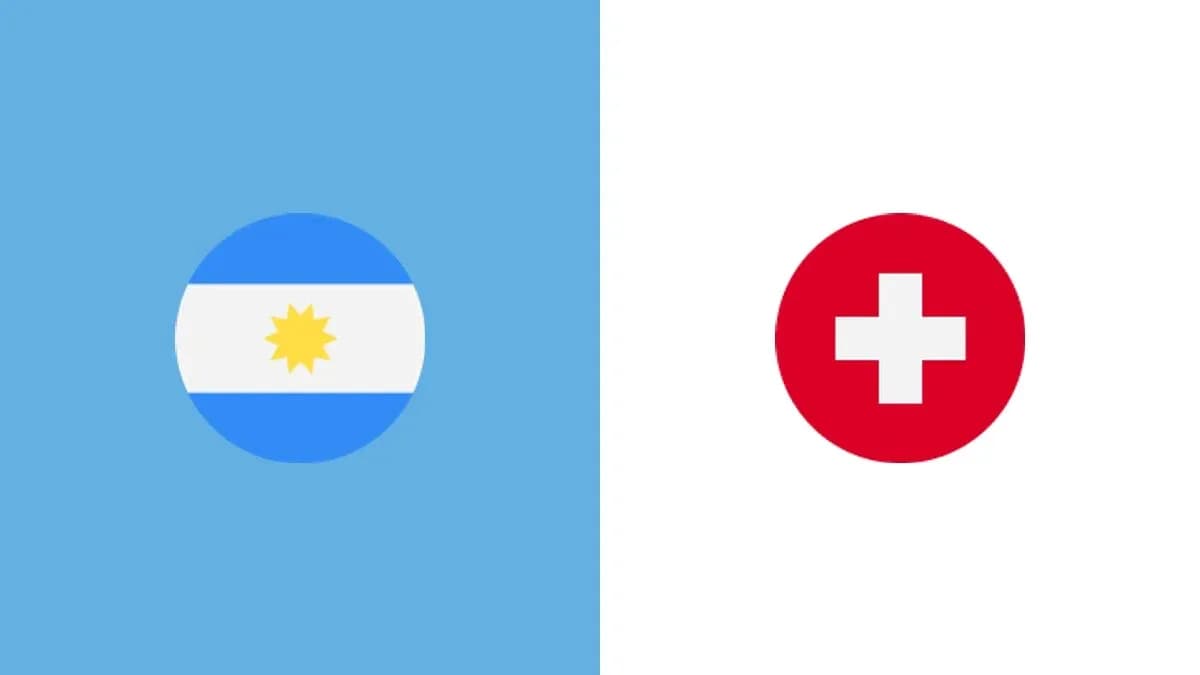

Argentina vs Switzerland: A Battle for World Cup Glory
The world champions know this script. The underdog does too.
On 12 July in Kansas City, Argentina step back into the World Cup spotlight carrying the weight of a nation and the scars of a chaotic title defence. Across from them, Switzerland arrive with something Argentina no longer possess at this tournament: a spotless record of control.
They have not trailed. Not once. Not in qualifying, not in the group, not in the knockouts.
Argentina? They’ve been living on the edge.
A champion’s path lined with jeopardy
Lionel Scaloni’s side surged through Group J as if on autopilot: three wins from three, 8 goals scored, 1 conceded, Jordan, Austria and Algeria all handled with the cold efficiency of a reigning champion. The numbers looked clean. The football was convincing. The aura remained intact.
Then came the knockouts, and the tone changed.
Against Cabo Verde in the round of 32, Argentina flirted with disaster, allowing three goals in a 3-2 win that left more questions than answers about their defensive stability. The Round of 16 against Egypt took that uncertainty and turned it into a full-blown crisis.
Down 2-0 with 11 minutes of normal time left, the holders stared at the brink. The crowd felt it. The players did too. What followed was pure World Cup mythology: Cristian Romero dragged them back, Lionel Messi – written off and rebuked for much of the night – redeemed himself, and Enzo Fernández rose in extra time to head in a 3-2 winner that will live in Argentine folklore.
That comeback stretched Argentina’s unbeaten World Cup run to 11 matches since 2022. It also underlined a truth about this team: they are no longer cruising through tournaments. They are surviving them.
Switzerland’s cold-blooded march
Murat Yakin’s Switzerland travel a different road. No chaos. No late rescues. Just a suffocating, calculated march into the last eight.
They topped Group B ahead of co-hosts Canada, conceding only twice in five matches across the tournament so far. A 1-1 draw with Qatar in their opener was followed by a ruthless 4-1 dismantling of Bosnia and Herzegovina, then a tight, controlled 2-1 win over Canada. Algeria were dispatched 2-0 in the Round of 32, a performance that felt more like a training exercise than a knockout tie.
The Colombia game in the Round of 16 told the rest of the story. Switzerland set their lines, shut down space, and refused to blink. Over 120 minutes they strangled a dangerous South American side, held them to a 0-0 draw and then walked through the penalty shootout 4-3 with the composure of a team that has rehearsed this scenario for years.
They have yet to concede in the knockout rounds. They have yet to crack under pressure. They look exactly like what they are: a hardened tournament side, built on defensive clarity and emotional control.
Messi’s last great chase
Hovering above all of this is Lionel Messi, 39 years old, still bending tournaments around his orbit.
He leads the Golden Boot race with eight goals and has scored in six straight competitive internationals. This is no farewell cameo. He is the central tactical problem for every opponent, and Switzerland are no exception.
Scaloni has reimagined him as a deep-lying playmaker who chooses his moments to arrive in the box. The system bends around his positioning. Alexis Mac Allister and Rodrigo De Paul shift and rotate in the half-spaces, constantly angling their bodies to find him between the lines. Leandro Paredes and Enzo Fernández handle the recycling and tempo, allowing Messi to drift, wait, and then punish.
Argentina’s likely XI reads like a continuation of that plan: Emiliano Martínez; Nahuel Molina, Cristian Romero, Lisandro Martínez, Nicolás Tagliafico; De Paul, Paredes, Fernández, Mac Allister; Messi and Lautaro Martínez up front. The only real attacking debate is whether Julián Álvarez’s tireless running might better complement Messi than Lautaro’s physical presence.
Scaloni has the luxury of a fully fit 26-man squad. He also has the burden of choice.
The Swiss block and the counter-punch
Yakin does not enjoy such comfort. His biggest concern is Johan Manzambi, the breakout Swiss star whose three goals have transformed their attacking threat. A knee injury kept him out of the Colombia tie, and his race to be fit for Argentina shapes the entire Swiss game plan.
If he fails to make it, AC Milan’s Ardon Jashari is again expected to join Remo Freuler and Granit Xhaka in a rugged, defensively tuned midfield. Michel Aebischer and Luca Jaquez remain out, working individually away from the main group.
The structure, though, is clear. Switzerland will likely line up with Gregor Kobel in goal; Denis Zakaria, Nico Elvedi and Manuel Akanji forming a flexible defensive line alongside Ricardo Rodriguez; Jashari, Xhaka and Freuler patrolling midfield; Dan Ndoye and Ruben Vargas flanking Breel Embolo up front.
Their mission is simple to describe and brutally hard to execute: deny Messi the central pockets he loves, hold a compact low-to-mid block, and explode into the wide channels the second Argentina’s full-backs overcommit.
Xhaka and Freuler will be the hinges. If they can screen the centre, force Argentina wide, and keep the game in front of them, Switzerland’s pace on the break becomes a genuine weapon. Ndoye and Vargas will target the spaces behind Molina and Tagliafico, while Embolo will look to pin the centre-backs and create lanes for runners.
Argentina’s back line has already shown it can be stretched. Switzerland intend to pull at every seam.
Battle for the middle
Strip away the narratives and this quarter-final is a fight for control of the middle third.
Argentina want to overload central zones, rotate constantly in the half-spaces and suffocate Switzerland with possession. They thrive when Mac Allister and De Paul can step inside, when Fernández can step forward, when Messi can receive on the half-turn between the lines.
Switzerland want to slam that door shut. Their defensive block will slide horizontally as a unit, cutting off passing lanes, forcing Argentina to circulate the ball in front of them and cross from less dangerous angles. From there, one interception, one loose pass, and they’re gone in transition.
The numbers frame the tension. Argentina have scored at least twice in 11 straight World Cup matches. Switzerland have not conceded a single goal in knockout play at this tournament. One streak breaks in Kansas City.
History leans one way, the moment another
On paper, history belongs to Argentina. Switzerland have never beaten them in any competition, trailing 15-3 on aggregate across their meetings. The last World Cup clash between these sides, in 2014, needed extra time before Argentina finally broke through for a 1-0 win in the Round of 16. Before that came a 3-1 friendly win for Argentina in 2012 and a 1-1 draw in 2007.
The past, though, does not carry you through a quarter-final.
This Swiss side is standing in territory their country has not seen for 72 years, not since they hosted the tournament in 1954. They have already made history by reaching this stage. They are now chasing something far greater: a first-ever World Cup semi-final.
Argentina, by contrast, are defending a crown and an identity. They arrive with five wins from five, 12 goals scored and five conceded, but with a lingering sense of vulnerability that did not exist in Qatar. The comeback against Egypt proved their resilience. It also exposed the cracks that a disciplined, well-drilled opponent like Switzerland will be desperate to widen.
The stakes in Kansas City
Two squads, 26 players each, bring depth and detail to this collision.
Argentina’s bench brims with options: Juan Musso, Gerónimo Rulli, veterans like Nicolás Otamendi and Marcos Senesi at the back, creativity from Giovani Lo Celso and Ezequiel Palacios, youthful energy from Valentín Barco and Nico Paz, and a forward line stacked with Julián Álvarez, Nicolás González, Thiago Almada, Giuliano Simeone and José Manuel López alongside Lautaro.
Switzerland counter with their own blend of experience and emerging talent: Kobel supported by Marvin Keller and Yvon Mvogo in goal; Akanji, Elvedi, Ricardo Rodriguez and Silvan Widmer anchoring the defence; Xhaka, Freuler, Jashari, Fabian Rieder, Djibril Sow and others knitting midfield together; Embolo, Zeki Amdouni, Cedric Itten, Ndoye and Noah Okafor offering variety in attack.
Form, history, structure, stars – all of it converges on a single night in Missouri.
Argentina must pick their way through a defensive wall that has yet to be breached in the knockouts. Switzerland must keep out a front line powered by the most decisive player of his generation, a man chasing another Golden Boot and perhaps one last tilt at immortality.
One side is playing to extend a dynasty. The other is playing to rewrite its own story.
Which breaks first: the champions’ nerve, or the underdog’s resistance?