.svg&w=384&q=75 "Naijagoal logo")

Thierno Barry's Impact on Everton's New Era
With fewer than 15 minutes left on opening day, Hill Dickinson Stadium rose as one. Not for a late winner, not for a desperate clearance off the line, but for a walk to the touchline.
Thierno Barry’s walk.
The stadium announcer had just confirmed the change: the match-winner departing, Beto coming on. As Barry strolled towards the dugout, he slowed, turned, and drank it all in – the applause, the songs, the sense that this, finally, was his Everton.
He had earned it.
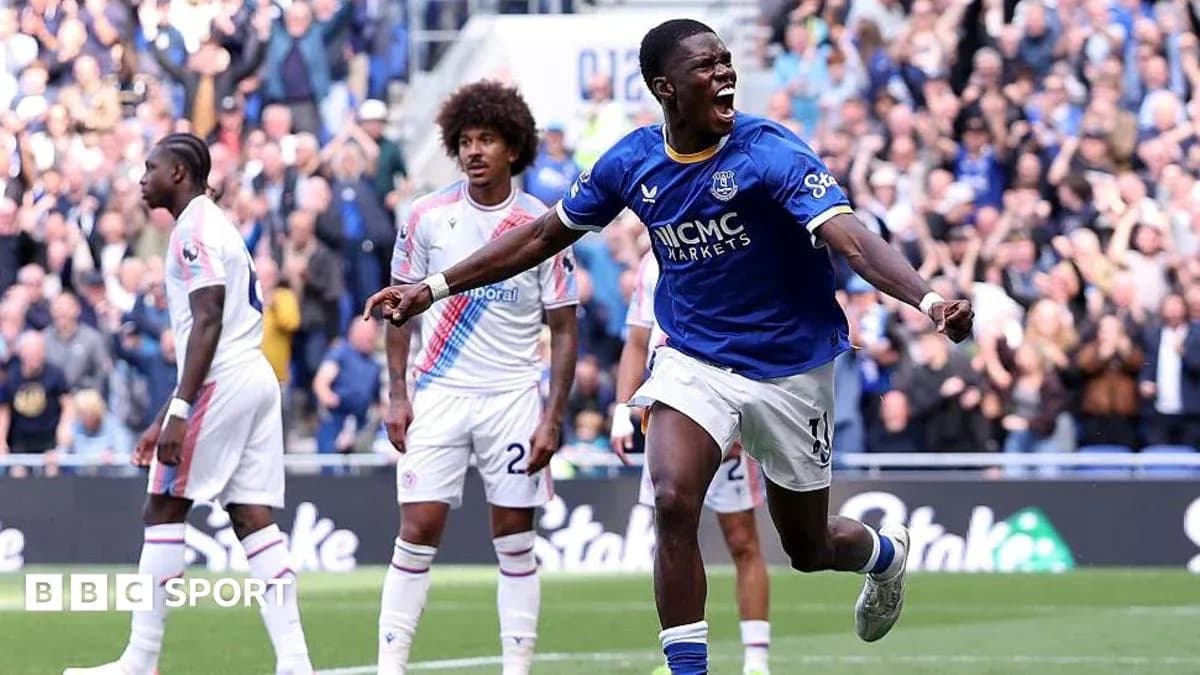
Earlier in the second half, with Crystal Palace still clinging to the idea of a comeback, Iliman Ndiaye arced in a teasing cross from the right. Barry attacked the space, timed his run, and buried his header. Everton 2-0 up, Palace’s resistance effectively broken, and the 23-year-old Frenchman grinning as he wheeled away in front of the Gwladys Street.
The joy in that moment could not have been further from the mood that surrounded him at the turn of the year. Back then, Barry looked like the emblem of a gamble that might not pay off: a £27m signing from Villarreal, an 11-goal La Liga season behind him, but stuck in a 14-game Premier League drought and running on fumes.
Strikers at this club know the scrutiny. Barry felt it early.
“Look, strikers will probably be judged on their goals, so he can walk away and be really happy with it,” David Moyes said afterwards. The Everton manager made sure the assist did not go unnoticed either. “I thought it would be wrong not to mention the quality of the cross from Ndiaye. Thierno getting in the right spot was huge and scoring with a header was really big for us because it was an important time in the game.”
Important for the match. Important for the player. Important for a club trying to drag itself into a new era.
When Barry arrived last summer, Everton were selling a vision of a brighter future while still picking through the debris of the recent past. A revolving door of managers. Relegation battles as an annual event. A points deduction for breaching the Premier League’s Profit and Sustainability Rules. The noise off the pitch was constant; the margin for error on it, tiny.
Moyes and his recruitment team knew the market they were shopping in. There would be no ready-made, Champions League-hardened No 9 walking through the door. Not with the finances tight and the club’s pulling power dulled by years of struggle. They needed potential. They needed someone they could grow.
Barry fit that profile. Young. Mobile. A decent La Liga record. But there was an understanding from day one: this would take time.
By mid-season, patience had started to fray. One goal in his first 18 Premier League appearances told its own story. The runs were there, the work rate too, but the penalty box felt like a foreign country. For a fanbase conditioned to expect a certain type of centre-forward, it was a hard watch.
Then January changed everything.
Barry caught fire. He began to score, to play with a little arrogance, to look like a striker who believed he belonged. By the end of his debut campaign he had eight Premier League goals in 38 games – not spectacular, but significant when set against where he had been. Half of those goals came after Everton lost their creator-in-chief, Jack Grealish, to a season-ending injury in January, stripping the side of its main supply line.
While some team-mates faded under the strain of chasing a European place, Barry’s form climbed. The numbers backed it up: eight goals from an expected goals figure of 8.1, a shot conversion rate of 21.1%, just a fraction shy of Erling Haaland’s 21.4%. Not bad company for a player supposedly still learning the trade.
That is the context behind the ovation as he left the pitch against Palace. Not just a thank you for a goal on the opening weekend, but a recognition of a journey – from misfiring signing to emerging talisman.
Moyes, though, has seen enough Premier League careers to know the danger of early hype. When he faced the media deep in the bowels of Hill Dickinson Stadium on Saturday night, there was no temptation to paint Barry as the finished product.
There were moments in the game that irritated him. Times when Barry drifted out wide without reason, vacating the central zones Everton needed him to occupy. Breaks that broke down because his first touch deserted him. Attacks that lost their edge when he tried to link play instead of pinning defenders.
“I need his build-up play to be better,” Moyes said. “I need him to be able to retain the ball for us so we can play into him more often.
“I want him to get in the right spaces, which he did today for the cross. He had a couple where the ball got played to him and he didn’t quite deal with it with his feet.
“Sometimes he is out linking up when he doesn’t need to be linking up. I think there is a lot to his game.
“I said last year that when you’re a young striker coming in, it’s not always easy. I think he’s come in with a really, really positive attitude this year.
“I think he’s come back with something that has stirred him up a little bit more, as if he’s got something to prove.”
Moyes knows what a prodigious Everton forward looks like. He lived that story with Wayne Rooney more than 20 years ago, guiding and hardening a teenager who would go on to define an era for club and country. Barry is older, his path different, but the principles are the same: channel the raw edges, sharpen the decision-making, turn promise into reliability.
The signs are that Barry is listening. The body language is different. The shoulders are looser, the movement more decisive, the finishes cleaner. He is no longer playing like a man terrified of the next miss.
Everton, too, feel subtly different with him at the tip of their attack – not yet transformed, but pointed towards something more ambitious than simple survival. The club that once lurched from crisis to crisis now has a young centre-forward walking off to a standing ovation on the opening day, a manager demanding more, and a sense that the story is only just getting started.
If this is Barry with “something to prove”, what happens when he proves it?