.svg&w=384&q=75 "Naijagoal logo")


Nasarawa United vs Rivers United: Tactical Insights from a 1–1 Draw
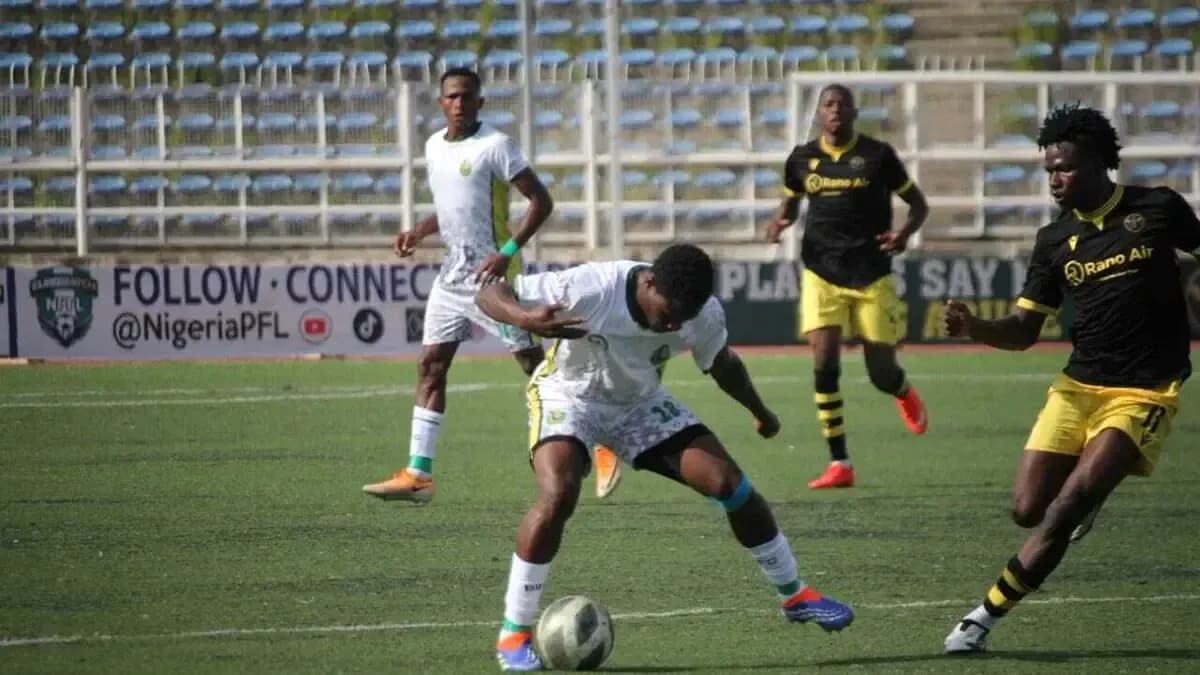
Under the late afternoon sun at Lafia Township Stadium, Nasarawa United and Rivers United played out a 1–1 draw that felt less like a routine Regular Season - 4 fixture and more like an early test of identity for both sides in the 2027 NPFL campaign. The result preserved Rivers United’s unbeaten start and underlined Nasarawa’s stubborn resilience at home, where they remain undefeated.
I. The Big Picture – Contrasting trajectories, converging on parity
Heading into this game, the table told a clear story. Nasarawa United sat 13th with 4 points from 4 matches, their overall record a patchwork of 1 win, 1 draw and 2 defeats. Their goal difference of -2 came from 4 goals scored and 6 conceded overall, and the pattern was stark: solid at home, fragile on their travels. At home they had played 2, winning 1 and drawing 1, scoring 2 and conceding just 1. Away, they had lost both games, with 2 goals for and 5 against.
Rivers United arrived in Lafia as one of the early pace-setters. Fourth in the table with 7 points from 3 matches, they were in the slipstream of the title and continental conversation. Overall they had 2 wins and 1 draw, with 5 goals scored and only 1 conceded, giving them a goal difference of +4. At home they had been impeccable: 2 wins from 2, 4 goals scored and none conceded. On their travels they had played just once, drawing 1–1, scoring 1 and conceding 1 – a pattern that this 1–1 in Lafia ultimately echoed.
The full-time scoreline – Nasarawa United 1, Rivers United 1 – fit the season’s emerging themes: Nasarawa tough to beat at Lafia Township Stadium, Rivers United disciplined but not yet dominant away from home.
II. Tactical Voids and Discipline – Edges and undercurrents
There were no officially listed absences in the data, so both coaches effectively had their core groups available. For Rivers United, Hakeem Busari again leaned on continuity, naming a strong XI that reflected a side comfortable in its early-season structure, even if the exact formation was not recorded.
Nasarawa’s disciplinary profile this season hints at a side that often has to fight its way into games. Their yellow cards are clustered in the 31–45 and 61–75 minute windows, each accounting for 50.00% of their total cautions. That split suggests emotional spikes around the end of the first half and just after the hour mark – moments where tactical fouls or lapses in composure can shape momentum. Rivers United, by contrast, had a single yellow card this season concentrated between 46–60 minutes (100.00% of their cautions), pointing to a team that tends to reassert physical control early in the second half rather than losing it.
Neither side has seen a red card this campaign, and both have a clean penalty record: no spot-kicks awarded, none scored, none missed. The battle in Lafia was always more likely to be decided in open play and through structural discipline than by set-piece chaos.
III. Key Matchups – Hunters, shields and the engine rooms
With no official top-scorer lists, the identities of the league’s headline finishers remain offstage, but the squads on the day reveal where each team’s attacking burden likely fell.
For Rivers United, the front half of the team is built around a mobile, interchanging band of attackers. E. Andy, wearing 32, and A. Dabai, in 7, offered vertical threat, while A. Oyowah, the number 10, carried creative responsibility between the lines. Around them, M. Chijioke (26) and W. Falolu (24) provided the running and width to stretch Nasarawa’s block, with T. Zachariah (31) a key outlet in the final third.
Their “shield” came from the collective, not just individuals. Overall this season, Rivers United have conceded only 1 goal in 3 matches, with an overall average of 0.3 goals against per game. At home that drops to 0.0 goals conceded per match; away it stands at 1.0. The back line, anchored by the likes of E. Akobundu (35) and O. Elias (22), has been drilled to protect central spaces, forcing opponents into lower-value wide areas.
Nasarawa’s “hunter” unit is more workmanlike but no less important. In attack, P. Samuel (10) is the natural reference point as a creative fulcrum, with A. Sunday (11) and J. Istifanus (35) providing energy and penetration around him. Behind them, the pairing of H. Ebah (5) and A. Abdullahi (6) offered ballast, screening a defensive line marshalled by figures such as C. Nduka (4) and A. Odinaka (27).
The engine room duel between Nasarawa’s central trio – Ebah, Abdullahi and Samuel – and Rivers United’s core, including S. Manyo (6) and A. Salman (14), shaped the rhythm. Rivers United’s season data shows a team that scores freely at home (4 goals in 2 matches, an average of 2.0) but is more measured away (1 goal in 1 match, an average of 1.0). Nasarawa, meanwhile, maintain a steady 1.0 goals for per match both at home and away, but with a defensive split: 0.5 goals against per game at home versus 2.5 away.
In that light, Nasarawa’s back four and keeper C. Olughu (31) were always going to be the key shield against a Rivers side that tends to control games rather than blow them open on their travels.
IV. Statistical Prognosis – What the numbers say about the draw
Overall this season, Nasarawa United’s attack has produced 4 goals in 4 matches, an average of 1.0 per game. Their defence has allowed 6, at an overall rate of 1.5 per match. At Lafia, however, their numbers sharpen: 2 goals scored and just 1 conceded across 2 home fixtures, maintaining that 1.0 goals for average but cutting their home goals against to 0.5 per game. This is a team that leans heavily on its home solidity to offset its away vulnerabilities.
Rivers United’s statistical profile is that of a contender. They have scored 5 goals in 3 matches overall, an average of 1.7 per game, while conceding just 1 at a rate of 0.3. Their home dominance – 4 goals for and 0 against in 2 matches – has been clear, but away from home they have so far been limited to a single 1–1 draw, with an away average of 1.0 goals for and 1.0 against.
Overlaying these trends, the 1–1 in Lafia feels almost inevitable. Nasarawa’s home defensive strength met Rivers United’s cautious, controlled away approach, producing a contest where neither side could fully impose its will. Nasarawa’s failure to keep a second home clean sheet will sting, but they also preserved their record of never failing to score this season – they have not drawn a blank in any of their 4 league matches so far.
For Rivers United, the draw extends their unbeaten run and maintains their strong goal difference, but it also underlines a subtle ceiling away from Port Harcourt. They remain difficult to break down, yet not quite ruthless enough on their travels to turn control into three points.
Following this result, the tactical verdict is clear: Nasarawa United have established Lafia Township Stadium as a credible fortress, while Rivers United continue to look like a balanced, defensively sound side whose next evolution will depend on adding a more decisive cutting edge away from home.