.svg&w=384&q=75 "Naijagoal logo")
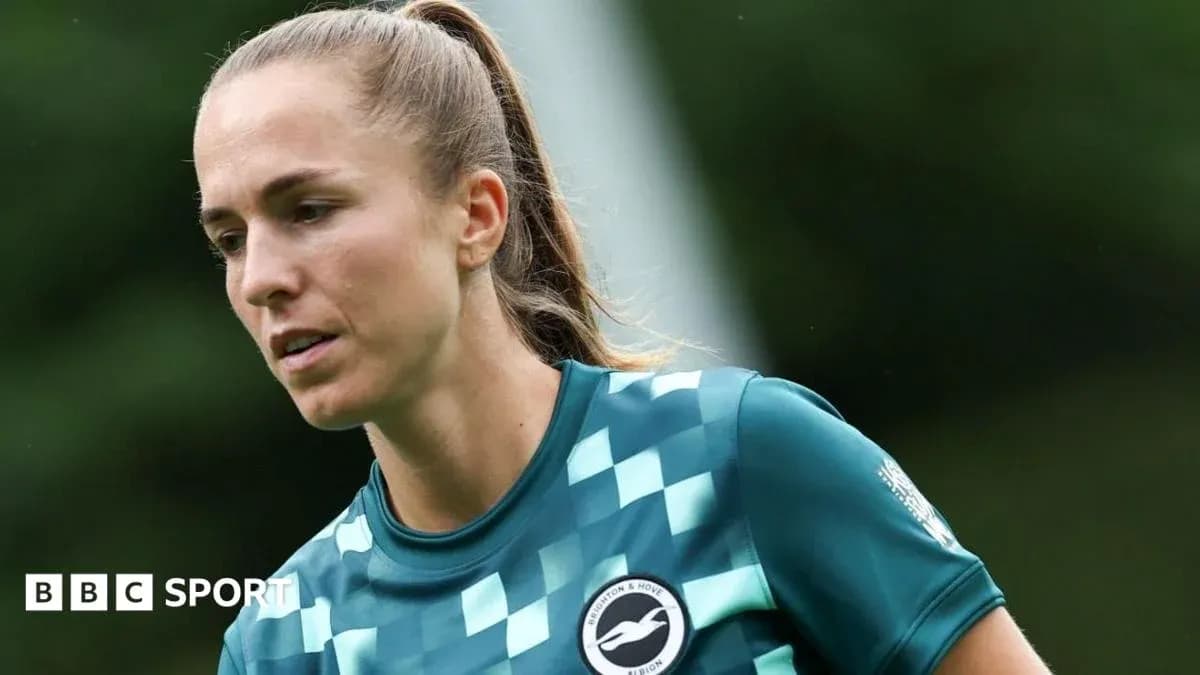

Lia Walti's Return to Brighton: From Juventus Frustration to WSL Opportunity
Lia Walti did not leave Juventus for a new adventure. She left because, in her words, she stopped feeling like a valued footballer.
The Switzerland captain has returned to England and the Women's Super League with Brighton after just one season in Italy, and she is blunt about why.
"I missed the feeling of being valued as a footballer, feeling like we're getting the full support we needed," she told BBC Sport. "It's such a huge difference."
From Arsenal glory to Italian frustration
Walti knows what a top environment looks like. Across seven years at Arsenal, she became one of the WSL’s most reliable midfielders, making 183 appearances and helping the club win four major trophies, including the Champions League and league titles. She lived through the surge in interest in women's football in England, the swelling crowds, the rising standards.
Last summer she chose Juventus, searching for a fresh challenge. What she found instead was a gulf.
She describes the contrast in professionalism between England and Italy as "extreme" and insists that, while she does not want to attack Serie A Femminile, the reality is stark.
"Football in England, in the WSL, has a standard which is not comparable with any other league," she said. "It's a bit sad and disappointing to see a lot of girls abroad do not have the same opportunities or standards in terms of being in professional environments."
The shock was not just about facilities or training. It was cultural.
"We had absolutely no fan culture – not just at Juve – in general in Italy," Walti explained. "In Italy, it was just [empty]. Every game felt a bit like that. I missed the feeling I had before when I was playing football."
She had grown used to full or buzzing stadiums in England, even when the grounds were small. Noise. Energy. A sense of occasion. That disappeared in Italy, and with it, part of her love for the weekly grind.
A wider problem in the women's game
Walti’s criticism is not limited to one club or one league. At 33, with more than 100 caps for Switzerland and the experience of captaining her country at Euro 2025 on home soil, she has become a voice for a generation that helped drag the women’s game into the mainstream in England.
"I think you have to bring the game to the people. You kind of have to force people to watch it. I felt that that's how it maybe started in England," she said.
She points to TV coverage as a basic, yet crucial, dividing line.
"In Italy, and in a lot of other countries, I think they have bad coverage. It's not shown [on TV] at all, or if it's shown, from where they film it, is really poor.
"It affects the way you watch a game. You don't really see the speed, the tactics or anything and you don't enjoy watching the game. In England, in the big stadiums, you can have great camera angles. I think people enjoy watching it more."
For Walti, the issues run deeper than broadcasts. They start underfoot.
"The biggest lacking starts with pitch quality. In a lot of countries, you play either on the worst artificial pitches or the worst natural grasses," she said. "Even if a Premier League team were to play there, it would probably look rubbish because it's just not possible to play nice football on it."
She stresses that this is not just an Italian problem. Switzerland faces similar issues. So do many leagues trying to grow without the financial clout or patience to build foundations.
"You have to do the first step – invest money for all those things before you get something back. I think a lot of countries don't have that money or patience."
Her frustration comes from a place of privilege and perspective.
"We used to not have good conditions. It wasn't professional. Our first salaries were not enough to live from," she said of the early days in England. "Now, seeing the growth in England and being with players who try to push the game in their own countries, it makes you feel frustrated to still see the reality."
"You forget sometimes, when you're in your own bubble, that this is not the norm. You're just one of the lucky ones who can experience it.
"A lot of talent in women's football gets lost because they are in bad environments where nobody sees them or they don't have the chance to reach their potential.
"I try to make an impact and I think that was really hard in Italy because I felt like when we spoke up, nothing happened, and that was frustrating."
Why Brighton made sense
By the time Walti sat down to decide her future, with a year left on her Juventus deal, she knew exactly what she wanted – and what she would no longer accept.
"After that experience in Italy, I knew a bit more about what I probably wanted, or didn't want," she said.
Brighton had already caught her eye during her Arsenal days. She had watched from across the league as the club poured money and intent into their women’s project.
In 2021, the women’s team moved into the American Express Elite Football Performance Centre after an £8.5m investment. In April this year, Brighton unveiled plans for Europe’s first purpose-built women’s football stadium, a £75-80m statement that the club sees the women’s side as a central pillar, not an afterthought.
On the pitch, Brighton reached their first Women's FA Cup final in May and have backed head coach Dario Vidosic in the transfer market. The aim is clear: break into the WSL’s top three and stay there.
Walti listened to players who had already been inside the building.
"I had a pretty big trust in Brighton before we had the conversations because I had been in the league and seen what the club was doing," she said. "I've heard from other players about the club investing a lot and I only heard really positive things. There is no better feedback than from other players."
When she finally walked through the doors, the impression matched the reputation.
"Once I started to have the first moments with the club, it proved to me that this is the right place – that cares about women's football, that invests in women's football, and who has the right people in place."
Brighton have signed a midfielder who has lived the best and the worst of the women’s game: the empty stands, the poor pitches, the full stadiums, the elite environments. Walti has chosen the WSL again because she believes it still sets the benchmark.
The question now is whether the rest of Europe is willing – or able – to catch up.