.svg&w=384&q=75 "Naijagoal logo")

Iraola's Liverpool: Rest Defence Issues Exposed Against Newcastle
Andoni Iraola walked into Liverpool with one big question hanging over him: could his football scale?
It worked at Rayo Vallecano. It worked at Bournemouth. High intensity, relentless running, collective aggression without the ball — that’s one thing when you’re scrapping in mid-table. It’s another when you’re expected to hunt down a Premier League title.
St James’ Park, opening day, Newcastle away. Not exactly a gentle introduction. The doubts about Iraola’s style — the physical toll, the risk, the space left behind — had been bubbling all summer. By kick-off, they were close to boiling.
Yet nobody expected the debate to centre on a concept as nerdy as rest defence.
Ninety minutes later, after a chaotic 2-2 draw that Liverpool were slightly fortunate to escape from, that was exactly where the conversation landed.
What Liverpool got wrong without actually being “out of possession”
Strip football down and you’re left with two basic states: you’ve got the ball, or you’re trying to get it back. Attack and defence. Simple enough.
The trick — and this is where Iraola’s Liverpool stumbled — lies in the split second between the two.
Rest defence, borrowed from the German Restverteidigung, is about that exact moment. Not “rest” as in taking a breather, but “rest” as in what’s left over. It describes how the players not directly involved in the attack are positioned and prepared in case the ball is lost.
When you’re pushing bodies forward, who’s left behind? Where are they standing? Who can reach the opposition’s most dangerous runners if possession flips?
Against Newcastle, Liverpool found out the hard way what happens when those answers aren’t good enough.
Both goals they conceded started with Liverpool in promising attacking positions. Both turned into Newcastle counter-attacks that cut straight through the soft underbelly of Iraola’s shape. You could blame the defending alone, but the rot started earlier — in how Liverpool attacked.
The first goal: a risky pass, a loose structure, and Elanga’s punishment
The warning signs were there the moment Ryan Gravenberch picked up the ball, spun away and surged into space.
He was the deepest of Liverpool’s midfielders. Dominik Szoboszlai had already joined the front line, darting in behind. Florian Wirtz drifted left, also thinking forward. All three were driving towards goal.
Behind them, a chasm opened up in front of the Liverpool defence.
In a well-organised rest-defence shape, someone has to be close enough to the opposition’s most dangerous out-balls. Here, Will Osula stood in exactly the pocket of space Newcastle wanted. No Liverpool player had clean access to him.
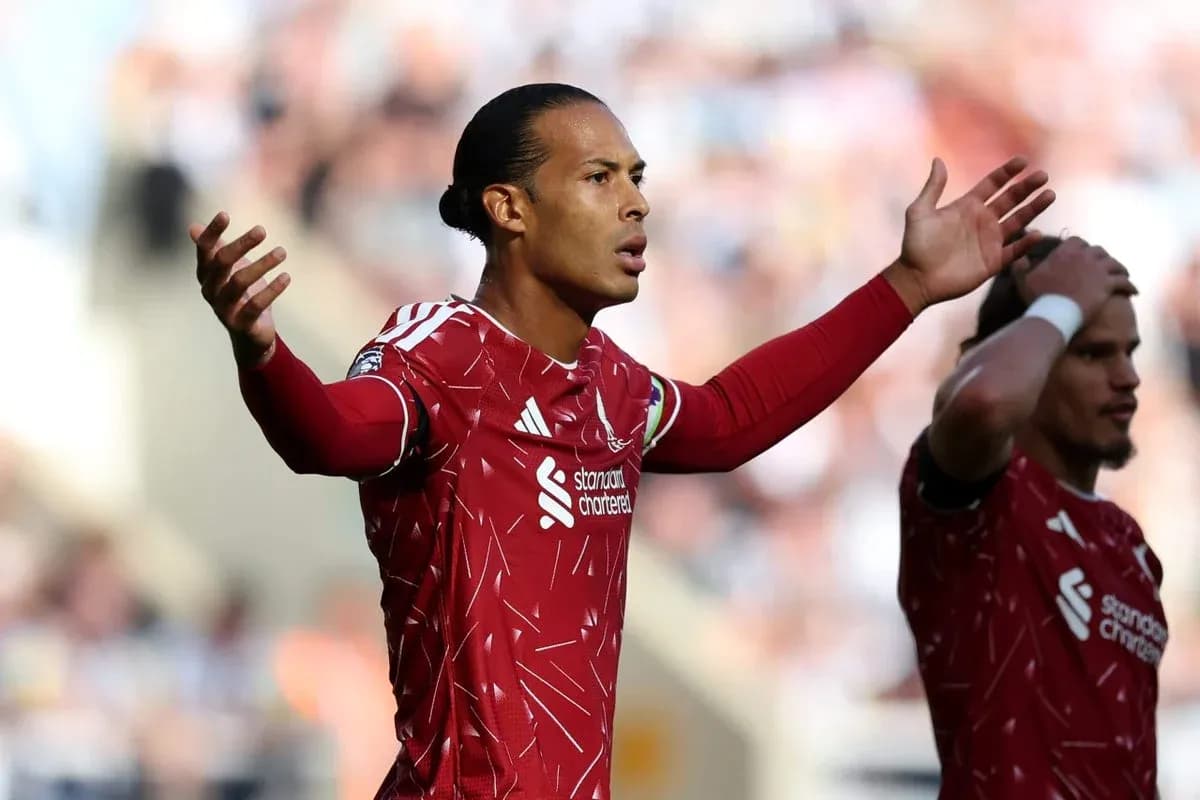
Virgil van Dijk sat too deep — something he later admitted. Wirtz stepped too high given Szoboszlai’s advanced position. The midfield line that should have been Liverpool’s safety net simply wasn’t there.
So when Gravenberch tried to slide a risky pass into Alexander Isak instead of shooting or finding Szoboszlai, the entire structure was exposed. The ball bobbled loose on the edge of Newcastle’s box. Amar Dedic prodded it away. Suddenly Osula had the ball, no pressure, and room to run.
It wasn’t just about shape, either.
Gravenberch had safer options. A shot would likely have ended the move, with the defence able to reset. A more difficult pass to Szoboszlai would at least have shifted the ball into a channel where the space in front of Liverpool’s back line mattered less. Instead, he picked the one option that maximised the danger if it went wrong.
Once the turnover happened, the dominoes kept falling.
Milos Kerkez wasn’t tight enough to Anthony Elanga to cut out Dedic’s weak pass. Had he been closer, he might have intercepted and killed the counter at source. Van Dijk failed to shepherd Osula towards the left touchline, allowing the forward to thread the pass into Elanga. Kerkez then backed off, giving one of the quickest players in the league a running start, inside track and a clear route to goal.
Elanga did the rest with a sharp, composed finish. Five minutes gone. 1-0 Newcastle. Liverpool’s rest defence had been ripped open before the game had even settled.
The second goal: same theme, slightly better structure, same punishment
The pattern repeated after the break.
This time, Liverpool’s starting positions were marginally improved. Szoboszlai had better access to Yoane Wissa in the central space that opened when Gravenberch pushed on and Wirtz tucked in more cautiously — almost certainly a half-time tweak.
Even so, the centre-backs still sat a touch too deep. One of them could have stepped up to tighten the space between the lines, leaving the other to guard the run in behind.
Again, the problem began with a decision on the ball.
Gravenberch, keen to improvise, tried an ambitious backheel in a crowded area. High-risk, low reward. When it failed, Newcastle were off again.
Wirtz and Szoboszlai sprinted back and did well initially to recover their positions, yet Wissa powered past both. At that point, the obvious question arises: why didn’t one of them commit the tactical foul, take the yellow card and reset?
Maybe they trusted the numbers behind them — Liverpool did have an overload against Newcastle’s forwards. It didn’t matter. Joe Willock arrived on the edge of the box, the ball broke his way, and he buried the chance.
Again, the duels were weak, the pressure too easy to ride. But once more, the root of the problem lay in how Liverpool had attacked and how they had prepared for the worst-case scenario if they lost the ball.
Iraola’s blueprint under the microscope
This is where the conversation circles back to “scalability”.
At Bournemouth, Iraola’s teams weren’t picked apart for their rest defence. Partly because expectations were different. Partly because they didn’t dominate the ball in the way Liverpool are expected to do.
Now the dynamic has flipped. Liverpool will have more possession, more territory, more bodies forward. That amplifies every structural weakness behind the ball.
The encouraging part for Liverpool is that these are fixable issues, not philosophical dead-ends.
The first layer of solutions is tactical. Players can adjust their starting positions. Midfielders can become more aware of each other’s runs, staggering their movements so that not all three surge forward at once. One centre-back can be instructed to step into midfield when the team is camped in the opposition half, closing the gap to potential counter-attacking outlets.
Crucially, none of this undermines what Iraola wants to do with the ball. The aggression, the vertical passing, the willingness to commit numbers forward — all of that can stay. It just needs a better safety net.
The second layer is personnel.
Gravenberch’s instinct is to carry forward and open up the pitch. That can be a weapon, but it also stretches the space in front of his defence. His team-mates have to anticipate that and adjust, or Iraola may decide that a different profile suits the deepest midfield role better.
Within the current squad, there are options. Trey Nyoni looked the most natural fit as the deeper midfielder in pre-season, showing a cleaner sense of balance between progression and protection. Alexis Mac Allister, if his legs can handle the workload, has also impressed in that role, offering more positional discipline.
None of that requires a transfer scramble. It requires clarity.
A different Liverpool to the one many expected
The irony is that many observers expected Liverpool to look chaotic in the press and clumsy in possession under a new coach. Instead, at Newcastle, they controlled large spells of the game, dominated the ball and created enough chances to win it.
They were undone not by a lack of ideas, but by what happened when those ideas broke down.
Twice, their attacking ambition met a flimsy rest-defence structure and some poor decisions on the ball. Twice, Newcastle sliced through the gaps. Twice, Liverpool paid.
For Iraola, that’s the early challenge. The style has scaled up to a bigger club. Now the security behind it has to grow with it — or the title talk will quickly sound like a language this team isn’t ready to speak.