.svg&w=384&q=75 "Naijagoal logo")

Bayern Munich Secures Supercup Win Against Borussia Dortmund
Bayern Munich have their first trophy of 2026/27 and, just as importantly, an early psychological edge. A 2-1 win away at Borussia Dortmund in the Franz Beckenbauer Supercup sounds tight. For 45 minutes, it was anything but.
Nathaniel Brown’s crisp opener on 28 minutes and a stoppage-time strike from Michael Olise gave Bayern a fully deserved 2-0 lead at Signal Iduna Park. Fabio Silva’s reply on 75 minutes gave Dortmund late hope and a touch of drama, but not a comeback.
Under the surface, though, the night told some familiar stories – and a few new ones.
Neuer: still world class, still a live wire
Risk has always been Manuel Neuer’s trademark. It’s the reason he changed goalkeeping. It’s also the reason Bayern still occasionally hold their breath when the ball rolls towards his feet.
The pattern is becoming clearer. The spectacular saves are still there. So are the wild moments.
The most brutal recent example came in April, when his misplaced pass to Arda Güler handed Real Madrid an early goal in the Champions League quarter-final second leg. In Dortmund, he flirted with that kind of disaster twice.
After 15 minutes, Neuer tried to play out through Min-jae Kim and mis-hit the pass badly. Dortmund suddenly had a route to goal, only for Kim to clean up with a sharp intervention that spared his captain any immediate inquest.
Late on, Neuer created his own mess. Kim rolled a routine back-pass towards him, BVB substitute Jobe Bellingham closed in, and the keeper tried to be cute. He shaped to let Bellingham run past, feinted behind his standing leg – and got it wrong. Bellingham suddenly had a clear look at the ball and a chance to make it 2-2. Neuer bailed himself out, flinging himself at Bellingham’s feet and smothering the danger.
Brilliant recovery. Needless risk.
Neuer has hinted this may be his final season. Bayern are already planning for that reality with Jonas Urbig, 23, who is expected to see more minutes this year as he is eased towards the No. 1 role. The idea is clear: Neuer still starts the biggest games. But with his distribution growing more erratic, the question becomes harder to ignore – at what point does that uncertainty open the door for Urbig on the biggest stages as well?
What hasn’t changed is Neuer on the line. His reflexes remain elite. Early in the second half, new Dortmund signing Konstantinos Karetsas forced him into a scrambling save from close range. Neuer twisted, reacted, and clawed away an awkward effort that most keepers would simply watch bounce in.
The shot-stopper is still there. The playmaker with the ball at his feet now comes with more risk than Bayern might like.
Nathaniel Brown, the surprise No. 10 – and Bayern’s new trump card
Bayern signed Nathaniel Brown as a left-back. On Saturday, he lined up as a No. 10 behind Harry Kane in Dortmund. That alone says plenty about how Vincent Kompany views his new signing.
With Jamal Musiala missing as he deals with a neurological dysfunction – and after collapsing in both recent friendlies against Leipzig and Heidenheim – Bayern needed a fresh solution between the lines. New arrival Ismael Saibari was not ready to start. Tom Bischof looked the obvious choice.
Kompany went a different way.
Brown, just a few weeks into his Bayern career, got the nod in the central role. It was a tactical gamble rooted in a clear idea. Kompany later explained that for Bayern, the spaces their full-backs occupy often mirror those of a No. 10, and that Brown is “unbelievably good between the spaces.” With Serge Gnabry, Lennart Karl and Musiala all unavailable, the coach leaned into that versatility.
The 23-year-old did not look like a natural playmaker in every phase. One or two moves broke down, as you would expect from someone still learning the patterns in a new position and a new team. But he was decisive when it mattered most.
Midway through the first half, Brown arrived in the right pocket, took his chance and lashed in the opener. One clean finish, one first trophy with Bayern, and one loud statement about his value to the squad.
Brown’s flexibility is not an isolated asset. Konrad Laimer can operate on either flank, as well as at No. 6, No. 8 or even No. 10. Josip Stanisic is comfortable on both sides of the defence and can slide into centre-back. For a club that expects to go deep in every competition, this kind of multi-role depth is not a luxury. It’s a weapon.
On Supercup night, Brown showed he might be one of Bayern’s sharpest new blades.
Kovac’s inverted wing-backs: promise, then a rethink
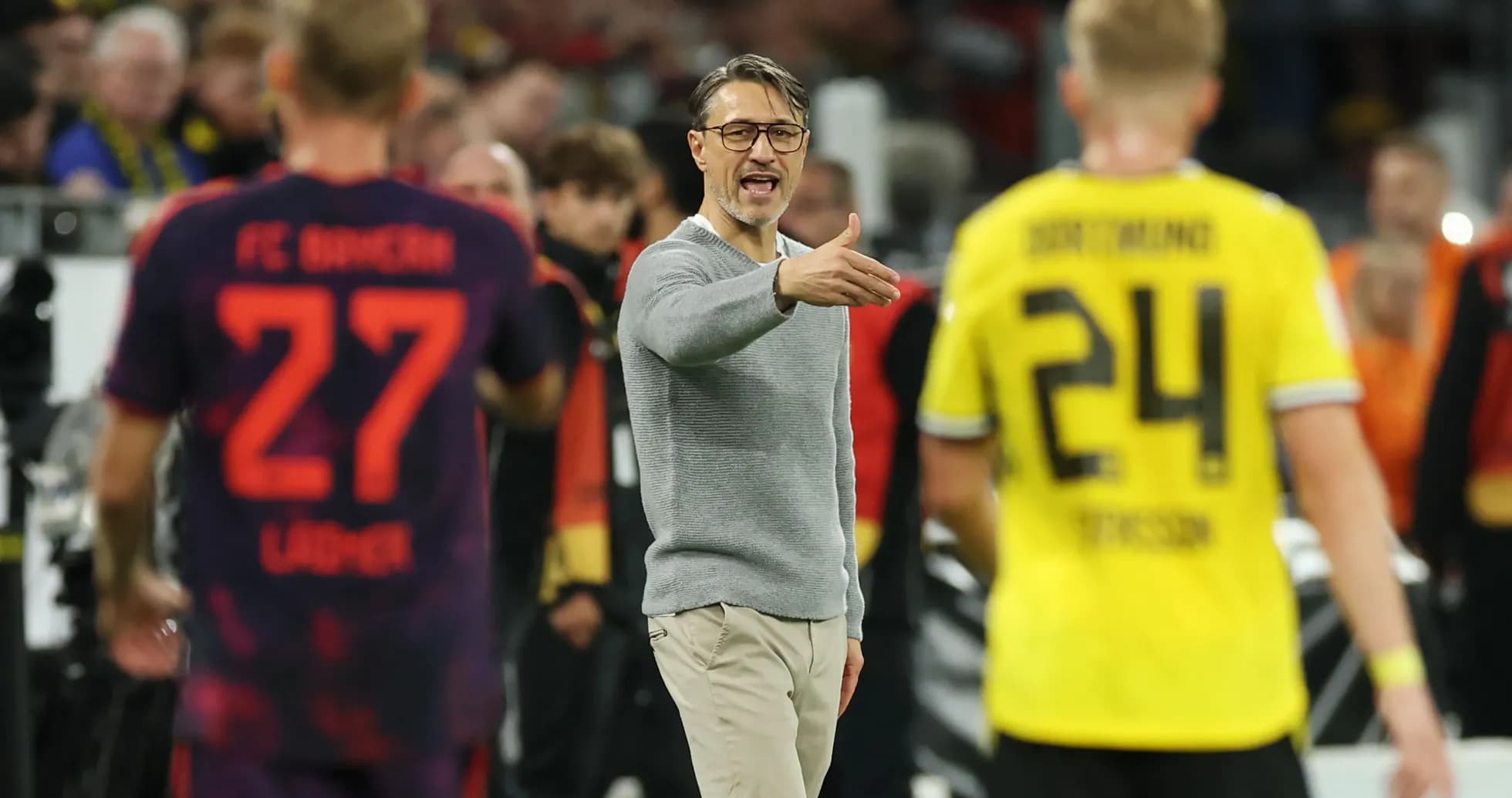
On the other bench, Niko Kovac used the Supercup as a testing ground. His experiment: inverted wing-backs.
From kick-off, left-footed Daniel Svensson started on the right, while right-footed Julian Ryerson took the left. The idea, as Kovac outlined afterwards, was clear. With opposite-footed players on each side, Dortmund would have more options to drive inside, combine, and shoot or slide passes through the middle – closer to what the top sides get from their wingers.
For a while, the tweak teased its potential. Ryerson, coming in from the left half-space on his stronger right foot, bent a dangerous cross towards the far post. Ramy Bensebaini got the faintest touch with his hair and the ball hit the net, but the flag went up. Offside, just.
The structure gave Dortmund some interesting angles. It also took something away.
By half-time, Kovac abandoned the trial. Ryerson and Svensson switched back to their natural flanks. “We saw that we had to change something,” he said, and added that the change “did us good.”
The game backed him up. Dortmund looked more direct and more dangerous after the break, especially down the wings. They got in behind more often, stretched Bayern, and finally turned pressure into a goal.
The 2-1 strike came from exactly the kind of move they had been missing in the first half. Svensson, now back on the left, burst to the byline and cut the ball back smartly. Fabio Silva arrived in the box and finished from close range with conviction.
There was another telling moment before the interval that underlined the downside of the inverted approach. Bensebaini drilled a low cross in from the left, and Svensson – having drifted in from the right – met it near the penalty spot. The ball sat up on his weaker right foot, his body shape was all wrong, and he swung at thin air. In his usual role, that chance probably falls to Ryerson on his stronger side. The outcome would likely be different.
Kovac’s tweak gave Dortmund new patterns but dulled some of their natural edge. His second-half correction brought the old threat back. The question now is whether he keeps experimenting once the league campaign starts, or locks in what clearly works.
Fabio Silva’s response – and a decision for Dortmund
Serhou Guirassy’s summer has gone quiet. The transfer noise around him has faded, and for now he looks set to stay at Borussia Dortmund for another season.
On the pitch against Bayern, though, the familiar problems resurfaced. Guirassy ran, pressed, battled. He rarely influenced the game. He had no real moment of danger.
After just over an hour, Kovac made his move. Guirassy came off, Fabio Silva came on. The change shifted the tone around Dortmund’s penalty area.
Silva, who had shown flashes in his first year at BVB, delivered again. For Dortmund’s goal, he dropped into a clever pocket, then attacked the box at exactly the right time, finishing ruthlessly from close range to make it 2-1. It was a simple goal, but it came from smart movement and sharp execution.
That cameo will not go unnoticed – either inside the club or outside it.
Several teams are tracking the 24-year-old, with Betis Sevilla recently viewed as the most serious suitor. Silva himself is reportedly not fixed on staying, and Dortmund’s hierarchy would be prepared to sell if the right offer lands on the table, even just a year after his arrival.
His impact against Bayern complicates that equation. Late in the transfer window, with limited time to find a replacement, BVB must weigh the short-term need for goals and depth against the financial logic of a sale.
Silva has made his statement on the pitch. Now the next move belongs to Dortmund’s decision-makers – and the clock is ticking.